
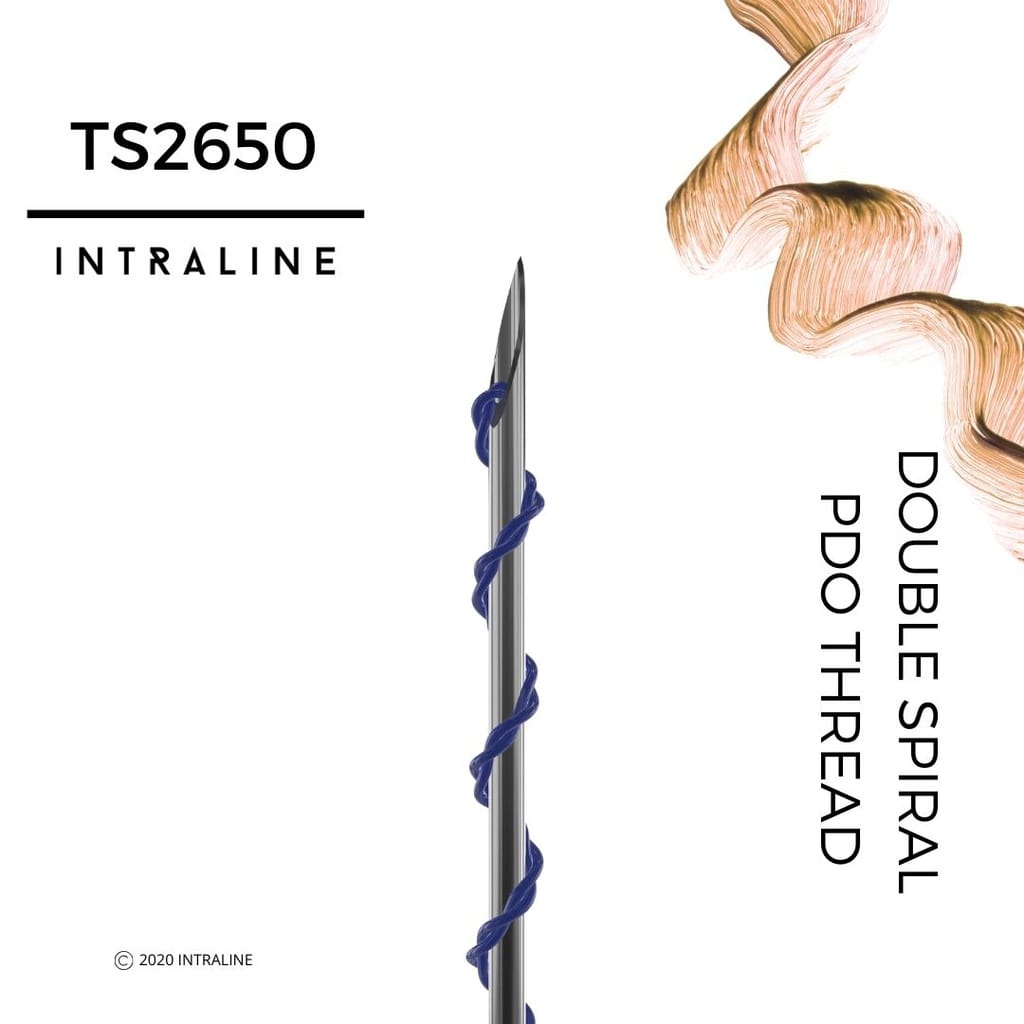
INTRALINE® PDO Threads TS2650- Double Spiral 26G 50/70mm 7-0,6-0
Order INTRALINE® PDO Threads TS2650 for Clinics
Medical Device
$129.00
You save
Description
INTRALINE® PDO Threads TS2650- Double Spiral 26G 50/70mm 7-0,6-0 are absorbable polydioxanone threads for professional aesthetic threading procedures. Licensed clinics, med spas, and healthcare professionals can order this double spiral 26G configuration for treatment-room workflows that require sterile, single-use thread handling and clear gauge, length, and suture-size identification.
The TS2650 format pairs a 26G placement platform with 50 mm and 70 mm thread lengths in 7-0 and 6-0 sizing. Clinics commonly evaluate this configuration when they need Professional PDO threads INTRALINE for soft-tissue approximation, vector-based support, and predictable handling during trained subdermal placement.
Clinic Price, Ordering, and Account Access
Sign in to view the current INTRALINE PDO Threads TS2650 price and request quotations for clinic procurement. Account-based access helps purchasing teams align order quantities with planned procedure volume, staff training schedules, and multi-room inventory needs without relying on consumer retail pathways.
Bulk order planning should account for configuration, gauge, thread length, suture size, sterile barrier integrity, lot number, and expiry. Your team can use the label information to match TS2650 units to internal protocols before stocking procedure carts or treatment-room cabinets.
Med Wholesale Supplies serves licensed clinics and healthcare professionals with brand-name medical products sourced through vetted distributors and verified supply channels. Orders can be coordinated with reliable US logistics, including temperature-controlled handling when required and tracked US delivery.
TS2650 Double Spiral 26G Specifications
INTRALINE TS2650 Double Spiral 26G is designed for subdermal placement by trained professionals using aseptic technique and clinic-approved protocols. The double spiral geometry distributes mechanical support along the placement tract, while the absorbable PDO material gradually resorbs after placement.
| Attribute | TS2650 detail |
|---|---|
| Brand | INTRALINE® |
| Configuration | Double Spiral |
| Placement platform | 26G |
| Thread lengths | 50 mm and 70 mm |
| Suture sizes | 7-0 and 6-0 |
| Material | Polydioxanone, commonly abbreviated PDO |
| Use setting | Professional aesthetic practice by trained personnel |
| Handling | Sterile, single-use device class; do not resterilize |
PDO is an absorbable aliphatic polyester used in resorbable suture applications. In aesthetic threading, trained clinicians place threads in selected tissue planes to support approximation along planned vectors. As PDO hydrolyzes, the material resorbs over time; tissue response and visible effect depend on patient factors, placement technique, product selection, and aftercare instructions.
Professional Use and Treatment-Room Fit
This class of aesthetic suture threads INTRALINE TS2650 fits workflows that prioritize precision, tactile feedback, and reproducible technique. The 26G platform is familiar to many threading providers and can support consistent staff training across facial zones when protocols are standardized by the clinic.
Clinicians may use double spiral PDO threads as part of comprehensive facial rejuvenation plans. Common professional-use areas include the midface, jawline, neck, perioral region, periorbital region, forehead, or glabellar areas when patient selection and treatment planning support placement. The product should be used only by appropriately trained professionals operating within local requirements and clinic policy.
For foundational technique context, the clinic team can review PDO thread mechanics and selection. For procedure planning that includes consent language and complication review, see thread lift risks and challenges.
Key Features for Inventory and Procedure Planning
- Absorbable PDO core made from a biocompatible polymer used in surgical suture contexts.
- Double spiral design that provides a coiled support profile along the tract.
- 26G placement platform for familiar handling in trained aesthetic threading workflows.
- 50 mm and 70 mm thread lengths for different treatment zones and vectors.
- 7-0 and 6-0 sizing for delicate tissue-plane objectives.
- Sterile, single-use presentation that supports aseptic procedure setup.
- Visible gauge, length, and size labeling for point-of-care verification.
- Lot and expiry information that supports clinic traceability records.
Quick tip: Store TS2650 units by gauge, length, and expiry date so staff can select the correct configuration before room setup.
Clinical Benefits and Practical Limitations
Double Spiral PDO threads 7-0 6-0 can help clinics standardize thread selection for fine support objectives while maintaining flexibility between 50 mm and 70 mm lengths. This is useful when providers need a configuration that fits established vectors without introducing a different gauge platform into every procedure plan.
PDO thread outcomes are technique-sensitive. The downside of a thread lift can include bruising, swelling, discomfort, asymmetry, dimpling, thread visibility, extrusion, infection, inadequate lift, or results that do not match patient expectations. These risks explain why some surgeons and aesthetic physicians prefer other approaches for certain anatomy, heavier tissue, surgical-level laxity, or patients who are poor candidates for minimally invasive lifting.
Threads are not a substitute for surgical lifting when tissue excess or laxity exceeds the realistic scope of a minimally invasive procedure. Clinics should use consultation, photography, medical history review, and informed consent to clarify likely benefits, limitations, and alternative modalities before treatment.
Composition, Mechanism, and Resorption
The active material is polydioxanone, often abbreviated PDO. PDO gradually breaks down through hydrolysis, a water-mediated chemical process that reduces the polymer over time. In the treated plane, the presence of the thread may also support tissue remodeling responses, although clinical effects vary by technique, anatomy, and patient biology.
The double spiral geometry is intended to distribute mechanical support more broadly than a simple straight thread tract. That design difference can influence how a trained provider plans vectors, tissue engagement, and combination use with other modalities.
For clinics comparing thread-based rejuvenation with neuromodulators, dermal fillers, or energy-based care, PDO threads and Botox treatment roles provides a practical comparison. The two modalities act differently and are often selected for different aesthetic goals.
Safety, Training, and Contraindication Checks
PDO thread placement should be performed only by trained professionals using sterile technique, appropriate anatomical knowledge, and documented patient selection criteria. Clinics should assess history of infection, bleeding risk, immune status, prior procedures, allergy history, medication use, scarring tendency, and realistic expectations before treatment.
Common post-procedure effects may include tenderness, swelling, bruising, mild irregularity, or temporary tightness. More serious complications can include infection, persistent pain, nerve irritation, vascular concerns, thread migration, extrusion, granuloma-like reaction, or contour distortion. Patients should receive aftercare instructions and escalation guidance consistent with the clinic’s medical protocols.
Professional disagreement about PDO threads usually centers on candidate selection, durability, technique variability, complication management, and whether a patient needs surgical correction instead. A careful consultation and conservative protocol help reduce mismatch between product capability and treatment goals.
Packaging, Storage, and Handling
This device class is supplied sterile for single use. Do not use a unit if the sterile barrier is open, punctured, wet, or otherwise compromised. Do not resterilize. Staff should verify the label, lot number, expiry date, and configuration before opening the sterile package.
Store in a clean, dry environment away from excessive heat, sunlight, and humidity. Treatment rooms should follow clinic infection-control procedures for preparation, placement, sharps handling, and disposal of used components.
Inventory teams can browse adjacent sterile device categories under medical devices and thread-specific configurations under aesthetic threads. Category browsing can support standardization across providers and procedure rooms.
Related INTRALINE Configurations
Clinics that use TS2650 may also keep related lengths or thread structures available for different anatomy and provider preference. Product selection should be directed by training, patient assessment, and the clinic’s approved protocol.
- INTRALINE® TS2638 Double Spiral 26G 38/50mm offers a shorter related double spiral configuration.
- INTRALINE® Triple TR2650 26G 50/70mm is a related 26G format for clinics evaluating a different thread structure.
- INTRALINE® Spiral 29G 50/70mm may be relevant when a different gauge and spiral format is clinically preferred.
For a broader manufacturer view, clinics can browse the INTRALINE brand portfolio. Keeping comparable configurations visible to procurement staff can reduce substitution errors and improve treatment-room readiness.
Authoritative Sources
Ready to add this configuration to your aesthetic threading toolkit? Sign in to request a quote, review current account pricing, and coordinate clinic supply planning for INTRALINE® PDO Threads TS2650- Double Spiral 26G 50/70mm 7-0,6-0.
This content is for informational purposes only and is not a substitute for professional medical advice.
Frequently Asked Questions
Who can order INTRALINE® PDO Threads TS2650?
INTRALINE® PDO Threads TS2650 are intended for licensed clinics, med spas, and healthcare professionals with appropriate training and professional-use protocols. Account access is required to view current pricing and request clinic quotations.
What does TS2650 mean for clinic selection?
TS2650 identifies the INTRALINE® Double Spiral PDO thread configuration with a 26G placement platform and 50 mm and 70 mm thread lengths in 7-0 and 6-0 sizing. Clinics should match the configuration to trained technique and approved treatment protocols.
How should clinics store and handle these PDO threads?
Store units in a clean, dry environment away from excessive heat, sunlight, and humidity. Verify gauge, length, suture size, lot number, expiry, and sterile barrier integrity before use. Do not resterilize or use if the package is compromised.
How long do PDO thread lift effects last?
Duration varies by patient anatomy, tissue quality, placement technique, thread selection, and aftercare. Clinics should avoid promising a fixed result timeline and should set expectations during consultation and consent.
What are the main downsides of PDO thread procedures?
Potential downsides include bruising, swelling, discomfort, asymmetry, dimpling, visible or palpable threads, extrusion, infection, inadequate lift, and results that do not meet expectations. Proper candidate selection and trained placement are essential.
Can TS2650 be substituted with another INTRALINE thread?
Substitution should be reviewed by the medical director or trained lead provider. Gauge, length, thread structure, suture size, tissue plane, and treatment objective all affect whether another configuration is clinically appropriate.
Specifications
- Main Ingredient: Polydioxanone (Pdo)
- Manufacturer: Mecobi Co. Ltd.
- Drug Class: Medical Device
- Generic Name: Polydioxanone (Pdo) Thread
- Package Contents: 20 threads
- Storage Requirements: Room Temperature (2℃~25℃)
- Main Usage:
About the Brand
Intraline
Counted among the cream of the crop in the medical sphere, Intraline is famed for its extensive array of groundbreaking, top-notch products tailored for the health sector. From cutting-edge dermal fillers to industry-leading PDO threads, Intraline has carved out a niche for itself as a credible entity within aesthetic medicine. A major distinguishing factor for Intraline lies in its unwavering dedication to delivering safe and result-oriented solutions for both health practitioners and patients. We, at medwholesalesupplies.com, take pride in featuring Intraline products for sale. Our digital platform is crafted to simplify the procurement process, providing a convenient shopping experience for medical professionals. Be it dermal fillers or PDO threads you're in search of, you can confidently rely on our platform to bring you the finest Intraline products, competitively priced. Thanks to our secure payment gateway and dependable shipping options, we offer you the peace of mind that comes with knowing you're investing wisely in the finest products for your practice. Shopping for Intraline products via medwholesalesupplies.com presents numerous advantages. First off, you're guaranteed authentic Intraline products, directly sourced from the manufacturer, attesting to their quality and safety. Furthermore, our compelling prices coupled with bulk buying options equate to significant cost savings while ensuring a consistent inventory of Intraline products for your practice. With our speedy, trusted shipping methods, you can comfortably expect to receive your Intraline items promptly. Choose medwholesalesupplies.com, your trusted source for premier Intraline solutions tailored to your health requirements.
Browse Intraline Products
Here to help
Questions about ordering, delivery or products? You can email our team here or call now at 1-800-630-9757 and be connected with your dedicated Account Manager
Related Products
Evenity® (English Alternative)
Injectable Medication
$1,229.00 - $1,299.00
You save
You save
Intraline® For Men
Dermal Filler
$59.00 - $79.00
You save
You save
RejuvaNAD+ Pro
Injectable Medication
$237.00 - $249.00
You save
You save
Teosyal® RHA 4
Aesthetic Surgery Product
$259.00 - $279.00
You save
You save
Related Articles
Prednisone in Clinical Care: Uses, Risks, and Monitoring
Prednisone is a prescription systemic corticosteroid used to reduce inflammation or suppress immune activity in…
Lip Fillers Swelling Stages: Timeline, Safety, and Follow-Up
Lip fillers swelling stages usually follow a short inflammatory course: swelling appears soon after injection,…
Hypopigmentation of the Skin: Assessment and Care
Hypopigmentation of the skin means one or more areas look lighter than the surrounding skin.…
Radiesse vs Sculptra: Selection Factors for Clinics
Radiesse vs Sculptra is best understood as a comparison between two collagen-stimulating injectables with different…
Hyaluronic Acid Under-Eye Filler: Safety and Workflow
Hyaluronic acid under-eye filler is an injectable soft-tissue filler used by trained aesthetic clinicians to…
Dermal Filler Types: Materials, Uses, and Clinic Fit
Dermal filler types are usually grouped by their base material, tissue behavior, and expected role…
What Is Dysport? Clinical Uses, Safety, and Workflow
For clinic teams asking what is Dysport, the short answer is simple: Dysport is a…
Biostimulators in Aesthetic Care: Selection and Safety
Biostimulators are injectable aesthetic products used to encourage a controlled tissue response, often involving new…