
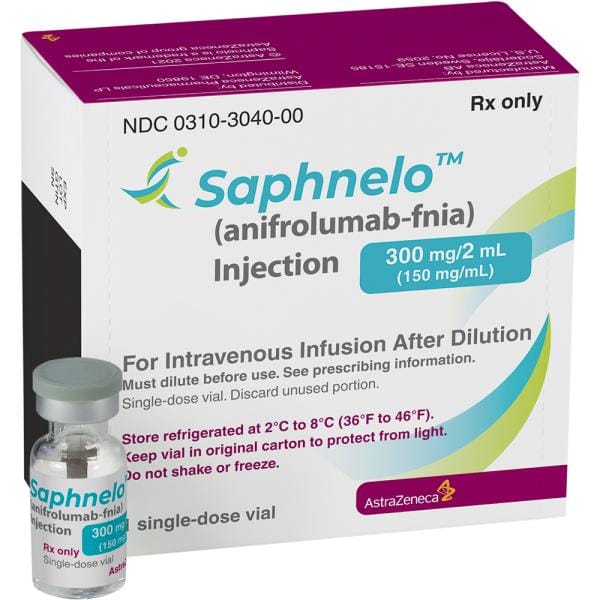
Saphnelo® 300mg/2ml International English
Order Saphnelo 300mg/2mL for Clinics
Prescription Medication
$3,799.00
You save
Description
Saphnelo® 300mg/2mL International English is a brand-name anifrolumab-fnia intravenous infusion product used in clinic-based systemic lupus erythematosus programs. Licensed clinics and healthcare professionals can order this sterile, preservative-free vial for professional preparation, dilution, and supervised IV administration. The 300 mg/2 mL presentation supports standardized infusion-suite workflows, pharmacist verification, lot traceability, and treatment-room documentation.
Anifrolumab-fnia is a monoclonal antibody that targets the type I interferon receptor. In practice, Saphnelo is used as add-on biologic therapy for adults with moderate to severe systemic lupus erythematosus who are receiving standard therapy, according to official labeling. It is not a chemotherapy drug; it is an immune-modulating biologic administered by intravenous infusion under healthcare-provider supervision.
Saphnelo 300mg/2mL Price, Vial Selection, and Clinic Ordering
Clinics can view the current Saphnelo 300mg/2mL price after account sign-in or quote request. Formal pricing may depend on current supply, order quantity, contract terms, and coordinated release planning for recurring infusion schedules. Use the vial strength shown during ordering to match your facility’s formulary build, prescriber protocol, pharmacy compounding process, and EMR item record.
The product is labeled as anifrolumab-fnia 300 mg/2 mL for intravenous use after dilution. The single-use vial format supports pharmacy-led preparation steps and nursing administration in controlled clinical environments. Before accepting stock into active inventory, reconcile the product name, strength, pack language, lot number, and expiry against your purchase order and internal item master.
Med Wholesale Supplies serves licensed clinics and healthcare professionals with brand-name medical products sourced through vetted distributors and verified supply channels. Ordering teams can coordinate Saphnelo alongside other autoimmune and biologic inventory through the Rheumatology category or broader Pharmaceuticals catalog when planning multi-product replenishment.
What Saphnelo 300 mg Is Used For
Saphnelo contains anifrolumab-fnia, a human monoclonal antibody indicated for adults with moderate to severe systemic lupus erythematosus who are receiving standard therapy. SLE is a chronic autoimmune disease in which immune activity can affect the skin, joints, blood, kidneys, nervous system, and other organ systems. Treatment plans are individualized by specialists, and biologic therapy is typically integrated with existing lupus medications and monitoring protocols.
The product’s role in a clinic program is not a stand-alone cure for lupus. It is an add-on biologic option for appropriate adult patients under specialist care. Labeling also notes limitations of use, including that Saphnelo is not recommended for severe active lupus nephritis or severe active central nervous system lupus. These limitations matter for formulary review, order-set design, and prescriber selection criteria.
For a professional infusion service, Saphnelo can be incorporated into recurring appointment blocks, nursing assessment templates, pharmacy checks, and post-infusion observation pathways. Facilities that manage autoimmune biologics often align this product with existing governance used for IV therapies and clinic-administered injectables. Adjacent rheumatology inventory may include Orencia vial for separate prescriber-directed indications and workflow planning.
How the IV Infusion Fits Professional Workflows
Saphnelo is an intravenous infusion, not a self-administered shot. The medication is supplied as a sterile solution that requires dilution before administration through an IV line by qualified personnel. Healthcare providers administering Saphnelo should be prepared to manage hypersensitivity reactions, including anaphylaxis, and infusion-related reactions, consistent with official HCP guidance.
Operationally, clinics should define pre-infusion screening, infusion-room observation, adverse-event escalation, and post-visit communication steps. The vial’s clear strength and lot information help pharmacy and nursing teams document product use, reduce transcription variability, and support traceability. A standardized EMR order set can also help align scheduling, pharmacy preparation windows, nursing assignment, and inventory decrementing.
Facilities that maintain multi-indication infusion suites may cross-train teams on biologic handling expectations, venous access documentation, emergency readiness, and reconciliation of clinic-administered medications. Related products such as MabThera 500 mg and Keytruda are used in different clinical contexts, but they illustrate why consistent biologic receiving, storage, preparation, and charting processes are important across service lines.
Active Ingredient and Mechanism
The active ingredient is anifrolumab-fnia. It binds to subunit 1 of the type I interferon receptor, blocking type I interferon signaling. Type I interferon activity is one immune pathway associated with systemic lupus erythematosus. By inhibiting receptor-mediated signaling, anifrolumab-fnia helps modulate an immune pathway involved in disease activity for eligible adult patients.
A monoclonal antibody is a laboratory-produced protein designed to bind a specific target. Saphnelo is not categorized as traditional chemotherapy because it does not work by broadly killing rapidly dividing cells. Its clinical relevance comes from targeted immune-pathway modulation, and its use should remain within prescriber-directed lupus treatment protocols.
For pharmacy and medical affairs teams, mechanism-based education can help staff distinguish Saphnelo from anti-TNF agents, CD20-directed antibodies, interleukin-targeting therapies, and other biologics. That distinction supports accurate counseling scripts, biologic class documentation, and adverse-event triage without implying interchangeability between products or indications.
Key Product Features
- Brand-name Saphnelo® International English presentation for professional use.
- Active ingredient: anifrolumab-fnia.
- Labeled strength: 300 mg/2 mL.
- Route: intravenous infusion after dilution.
- Sterile, preservative-free solution.
- Single-use vial for pharmacy preparation and clinic administration.
- Intended for qualified healthcare-provider administration in monitored settings.
- Lot and expiry details support regulated inventory traceability.
- Compatible with standardized biologic ordering, receiving, and EMR documentation workflows.
Packaging, Storage, and Handling
The International English pack is supplied as a single-use vial labeled 300 mg/2 mL. The outer carton and primary label provide product identification, pack language, lot information, and expiry dating for receiving and reconciliation. On arrival, route the product through your established temperature-monitoring, quarantine, and release process before making it available for scheduled infusion visits.
Storage, transport, dilution, and in-use stability should follow the manufacturer’s current labeling and facility policy. Do not co-mix Saphnelo with other agents unless supported by manufacturer instructions and your internal procedures. Pharmacy teams should prepare infusion materials using approved aseptic workflow, and nursing teams should document administration according to clinic protocol.
Med Wholesale Supplies can coordinate temperature-controlled handling when required and tracked US delivery. Because infusion programs often depend on predictable treatment calendars, align ordering cadence with appointment volume, par levels, and replenishment thresholds. Maintain lot segregation when required by policy, and capture product identifiers in the EMR or inventory system before administration.
Safety, Warnings, and Monitoring
Saphnelo requires clinical oversight because biologic immune modulation can increase infection risk and may cause infusion-related or hypersensitivity reactions. Common adverse events reported in labeling include nasopharyngitis, upper respiratory tract infection, bronchitis, infusion-related reactions, cough, and herpes zoster. Infusion-related symptoms may include headache, nausea, vomiting, fatigue, dizziness, and chills.
Serious hypersensitivity, including anaphylaxis, has been reported. Clinics should keep emergency response procedures, trained personnel, and appropriate supplies available during administration. Staff should assess patients before infusion, monitor during administration, and document any reaction according to clinic policy. Treatment interruption or discontinuation decisions belong to the treating clinician.
Vaccination review is an important operational step before biologic therapy. The official label advises avoiding live or live-attenuated vaccines in patients receiving Saphnelo. Screening procedures should also address active or chronic infection concerns, prior herpes zoster history, and other patient-specific risk factors defined by prescriber protocols.
Drug interaction considerations should be managed through pharmacy and prescriber review. Saphnelo is often used with standard lupus therapy, but product-specific suitability depends on the overall medication regimen, immune status, infection history, and disease manifestations. Clinics should provide clear reporting pathways for fever, worsening respiratory symptoms, rash, shingles-like pain or blisters, or symptoms suggestive of an infusion reaction.
Benefits for Infusion Program Management
Clinics value Saphnelo for recurring biologic administration within structured SLE pathways. A consistent vial strength and single-use presentation can simplify pharmacy verification, nursing preparation checks, barcode capture, and inventory cycle counts. Predictable product identification also helps reduce manual reconciliation burden when multiple biologics are stored in the same controlled area.
Chair utilization is a practical consideration for autoimmune infusion services. Build appointment templates that account for intake, preparation release, IV placement, administration, monitoring, and documentation. Clear timing assumptions help reduce bottlenecks between pharmacy and nursing while supporting patient throughput and safety oversight.
Quick tip: Match the vial record, EMR build, and purchase-order language before adding new stock to active inventory.
For facilities expanding biologic capacity, Saphnelo can sit within a broader governance framework that includes formulary approval, staff competency records, adverse-event reporting, and inventory controls. Other clinic-administered biologics, such as Xolair or Cimzia pre-filled syringes, involve different indications and administration requirements, but they may share receiving, documentation, and staff training principles.
Comparable Products and Portfolio Planning
Saphnelo should be evaluated according to its labeled lupus indication, mechanism, route, safety profile, and prescriber protocols. It is not interchangeable with other biologics simply because they are used in autoimmune, inflammatory, or infusion-suite settings. Pharmacy and therapeutics committees should assess each product by indication, route, preparation needs, monitoring requirements, and local clinical pathways.
Rheumatology and multispecialty clinics often carry biologics across several disease areas. For example, abatacept, certolizumab, rituximab, omalizumab, and pembrolizumab products may require different screening, storage, administration, or monitoring processes. Keeping clear category separation helps prevent formulary confusion and supports safe staff education.
When adding Saphnelo to an existing portfolio, confirm whether new order sets, nursing competencies, infusion reaction algorithms, or pharmacy compounding instructions are needed. Cross-functional review among rheumatology, pharmacy, nursing, procurement, and revenue-cycle stakeholders can reduce implementation delays and support consistent patient-care operations.
Documentation and Receiving Checklist
Receiving teams should reconcile the shipment against the clinic purchase order before release to inventory. Confirm product name, active ingredient, strength, pack language, lot number, expiry date, and carton condition. Record temperature-monitoring data according to internal policy, especially when cold-chain or controlled handling requirements apply.
Before first use, verify that the EMR medication build reflects the same product identity and strength. Pharmacy staff should ensure dilution instructions, compatibility notes, beyond-use handling, and administration details align with the current manufacturer information. Nursing documentation should capture administered medication, lot if required, infusion start and stop data, patient tolerance, and any adverse events.
Why it matters: Consistent documentation supports traceability, audit readiness, and safer biologic administration across recurring visits.
Authoritative Sources
Manufacturer HCP dosing and administration information
Official prescribing information
NIAMS systemic lupus erythematosus information
This content is for informational purposes only and is not a substitute for professional medical advice.
Frequently Asked Questions
Is Saphnelo 300 mg a shot or an infusion?
Saphnelo 300 mg/2 mL is an intravenous infusion product. It is supplied as a sterile vial that is diluted and administered by qualified healthcare staff in a monitored clinical setting.
What is Saphnelo 300 mg used for?
Saphnelo contains anifrolumab-fnia and is used as add-on biologic therapy for adults with moderate to severe systemic lupus erythematosus who are receiving standard therapy. It is not recommended for severe active lupus nephritis or severe active central nervous system lupus.
Is Saphnelo considered chemotherapy?
No. Saphnelo is a monoclonal antibody biologic that blocks type I interferon receptor signaling. It is an immune-modulating therapy, not traditional chemotherapy.
How can clinics view the Saphnelo 300mg/2mL price?
Licensed clinic accounts can sign in or request a formal quote to view current Saphnelo 300mg/2mL pricing. Cost may vary with supply, quantity, contract terms, and coordinated release planning.
What should clinics verify when receiving Saphnelo stock?
Receiving teams should confirm product name, 300 mg/2 mL strength, pack language, lot number, expiry date, carton condition, and temperature documentation according to facility policy before releasing stock to active inventory.
What safety precautions matter during administration?
Clinics should be prepared to manage hypersensitivity and infusion-related reactions, including anaphylaxis. Staff should also monitor for infection concerns and follow vaccination guidance, including avoidance of live or live-attenuated vaccines during therapy.
Specifications
- Main Ingredient:
- Manufacturer: AstraZeneca
- Drug Class: Biologic
- Generic Name: Anifrolumab
- Package Contents: 1 Vial
- Storage Requirements: Room Temperature (2℃~25℃)
- Main Usage:
Here to help
Questions about ordering, delivery or products? You can email our team here or call now at 1-800-630-9757 and be connected with your dedicated Account Manager
Related Products
Evenity® (English Alternative)
Injectable Medication
$1,229.00 - $1,299.00
You save
You save
Intraline® For Men
Dermal Filler
$59.00 - $79.00
You save
You save
RejuvaNAD+ Pro
Injectable Medication
$237.00 - $249.00
You save
You save
Teosyal® RHA 4
Aesthetic Surgery Product
$259.00 - $279.00
You save
You save
Related Articles
Prednisone in Clinical Care: Uses, Risks, and Monitoring
Prednisone is a prescription systemic corticosteroid used to reduce inflammation or suppress immune activity in…
Lip Fillers Swelling Stages: Timeline, Safety, and Follow-Up
Lip fillers swelling stages usually follow a short inflammatory course: swelling appears soon after injection,…
Hypopigmentation of the Skin: Assessment and Care
Hypopigmentation of the skin means one or more areas look lighter than the surrounding skin.…
Radiesse vs Sculptra: Selection Factors for Clinics
Radiesse vs Sculptra is best understood as a comparison between two collagen-stimulating injectables with different…
Hyaluronic Acid Under-Eye Filler: Safety and Workflow
Hyaluronic acid under-eye filler is an injectable soft-tissue filler used by trained aesthetic clinicians to…
Dermal Filler Types: Materials, Uses, and Clinic Fit
Dermal filler types are usually grouped by their base material, tissue behavior, and expected role…
What Is Dysport? Clinical Uses, Safety, and Workflow
For clinic teams asking what is Dysport, the short answer is simple: Dysport is a…
Biostimulators in Aesthetic Care: Selection and Safety
Biostimulators are injectable aesthetic products used to encourage a controlled tissue response, often involving new…