

- You must be logged in to add items to the cart.
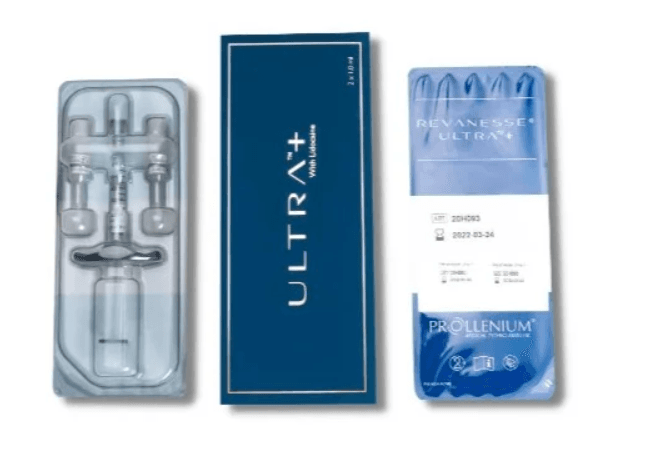
Revanesse®Ultra™ w/ Lidocaine
Order Revanesse® Ultra™ with Lidocaine for Clinics
Dermal Filler
$259.00
You save (%)
Description
Revanesse® Ultra™ with Lidocaine is a sterile, prefilled hyaluronic acid dermal filler for professional injection by trained healthcare providers. Licensed clinics and aesthetic practices can order Revanesse Ultra with Lidocaine in a two-syringe pack, with each syringe containing 1.2 mL of gel. The premixed 0.3% lidocaine supports injection comfort, while the 25 mg/mL hyaluronic acid formulation fits clinic protocols for volume restoration, fold correction, and contour refinement.
Med Wholesale Supplies serves licensed clinics, med spas, and healthcare professionals that need authentic brand-name aesthetic products sourced through vetted distributors and verified supply channels. Revanesse® Ultra™ with Lidocaine is stocked for treatment-room workflows that require sealed sterile units, visible lot and expiry information, and reliable US logistics.
Product Format, Strength, and Clinic Ordering Details
Revanesse® Ultra™ with Lidocaine is supplied as a clear, colorless injectable gel in ready-to-use syringes. Each box contains two sterile syringes with 1.2 mL per syringe. The formulation includes hyaluronic acid 25 mg/mL and lidocaine 0.3%, giving practices a standardized HA filler presentation for scheduled aesthetic procedures.
Clinics can sign in to view current Revanesse Ultra with Lidocaine price information, pack availability, and account-specific purchasing details. The two-syringe format helps teams plan treatment rooms, allocate inventory across provider schedules, and reduce the need to open additional units when one session requires more than a single 1.0 mL-type volume.
| Attribute | Clinic-relevant detail |
|---|---|
| Product type | Hyaluronic acid dermal filler with lidocaine |
| Presentation | Prefilled sterile syringes |
| Pack size | 2 syringes per box |
| Fill volume | 1.2 mL per syringe |
| HA concentration | 25 mg/mL |
| Lidocaine | 0.3% premixed anesthetic component |
| Primary setting | Professional aesthetic injection in clinical environments |
For broader Revanesse inventory planning, clinics can review the Revanesse brand selection alongside other products used in aesthetic injection programs. Keep purchase decisions aligned with provider training, clinic protocols, and the specific treatment plans established during consultation and assessment.
What Revanesse® Ultra™ with Lidocaine Is Used For
Revanesse® Ultra™ with Lidocaine is used by trained injectors as a hyaluronic acid filler to restore volume, smooth pronounced facial folds, and refine contours. In practice, providers may use this type of gel for moderate-to-severe facial lines, midface support, contour restoration, and perioral refinement when appropriate for the patient’s anatomy and treatment goals.
Hyaluronic acid is a water-binding molecule used in dermal filler gels to provide temporary structure and hydration within soft tissue. Lidocaine is included to reduce discomfort during injection. The product should be placed only by healthcare professionals trained in facial anatomy, aseptic technique, filler selection, and complication management.
Many clinics evaluate Revanesse Ultra hyaluronic acid filler by balancing handling, extrusion, patient comfort, and the type of correction required. For a Revanesse-focused discussion of feature-level treatment planning, see Revanesse filler precision aesthetics. For broader category planning, the article on popular dermal fillers for facial areas can help teams frame product selection by region and treatment objective.
Gel Handling and Treatment-Room Fit
Clinics value Revanesse® Ultra™ with Lidocaine for a familiar prefilled format that supports predictable setup. The clear gel presentation helps providers maintain visibility during preparation, while the sealed syringe format supports clean handling before injection. Lot and expiry details on the packaging assist with intake checks, charting, and inventory control.
The 1.2 mL syringe volume can be useful when providers plan multi-point correction or adjacent treatment areas. A larger-than-1.0 mL syringe can reduce interruption in selected cases, but the final amount used should always reflect clinical assessment, patient-specific anatomy, and the injector’s technique. Do not reuse syringes, and discard opened units according to clinic policy and local sharps or biohazard procedures.
Quick tip: Record lot, expiry, syringe count, and treatment area before the product leaves the treatment-room tray.
Composition and Ingredients
The core formulation contains hyaluronic acid 25 mg/mL in an injectable gel vehicle with lidocaine 0.3%. Hyaluronic acid contributes the filling and soft-tissue support effect, while lidocaine helps improve comfort during placement. The product is supplied sterile and should be inspected before use to verify that the blister, seals, syringe, and labeling are intact.
Revanesse® Ultra™ with Lidocaine should be used with sterile injection accessories selected by the provider and consistent with product instructions, clinic training, and institutional procedures. Do not use a syringe if packaging appears damaged, opened, contaminated, or otherwise compromised. Maintain aseptic technique from tray setup through disposal.
For teams specifically evaluating the anesthetic component in filler procedures, the role of lidocaine in dermal fillers explains why many practices choose premixed lidocaine fillers for comfort-focused workflows.
Ordering, Price, and Professional Supply Logistics
Verified clinic accounts can order Revanesse Ultra with Lidocaine online and view current cost information after signing in. Pricing may vary by account terms, quantity, and current wholesale availability, so practices should use live account details when planning campaigns or recurring filler days. For high-volume use, coordinate expected needs before scheduling multiple providers or promotional treatment blocks.
Orders are handled through professional wholesale channels, with temperature-controlled handling when required and tracked US delivery. Clinics can consolidate related aesthetic products and procedure supplies into a single cart when operationally helpful. Support staff can assist with documentation requests or product cross-referencing, while clinical product selection remains the responsibility of the treating professional.
Practices building or refreshing filler inventory may also find wholesale dermal filler planning useful for stock management, purchasing cadence, and clinic workflow considerations.
Safety, Contraindications, and Monitoring Considerations
Expected injection-site reactions may include swelling, bruising, redness, tenderness, pain, firmness, itching, or temporary discoloration. These effects are often self-limited, but clinics should provide appropriate post-procedure instructions and maintain a clear process for patient follow-up. Any reaction that is severe, persistent, worsening, or unusual should be assessed by a qualified healthcare professional.
Dermal filler procedures can carry serious risks when product is injected into or compresses a blood vessel. Potential complications may include tissue injury, visual disturbance, infection, nodules, inflammatory reactions, or allergic-type responses. Providers should screen for relevant medical history, review prior filler or procedure history, and use careful injection technique with an understanding of facial vascular anatomy.
Do not inject into areas with active infection, inflammation, or compromised skin unless a qualified clinician determines treatment is appropriate after resolution. Clinics should also consider patient-specific factors such as bleeding tendency, use of anticoagulants or antiplatelet agents, immune status, allergy history, pregnancy or lactation considerations, and history of hypertrophic scarring or keloids. Policies should include emergency response procedures and staff training for recognition of vascular compromise and other complications.
For a regulator-backed safety perspective on Revanesse Ultra, clinics may consult the Revanesse Ultra patient information sheet. Authoritative materials support clinical counseling but do not replace provider training, product instructions, or local medical protocols.
Packaging, Storage, and Inventory Control
Each box contains two sealed sterile syringes packaged to protect sterility before use. Receiving staff should inspect shipment contents, confirm the product name, verify syringe count, and record lot and expiry information according to clinic policy. Store the product according to manufacturer instructions and keep it in its packaging until preparation for treatment.
Inventory teams should rotate stock by expiry date and separate quarantined units if packaging integrity is in question. Because aesthetic schedules can shift quickly, clinics should confirm quantity needs before high-volume treatment days and avoid opening sterile packaging until the provider is ready for setup. Clear receiving and tray-preparation workflows reduce waste and support traceability.
Why it matters: Lot-level documentation helps clinics respond quickly if a manufacturer notice or internal quality review occurs.
How It Compares Within the Revanesse Range
Revanesse fillers are selected by indication, anatomy, desired structure, and injector preference. Revanesse® Ultra™ with Lidocaine is commonly positioned as a versatile HA filler for folds, volume support, and contour refinement. Other Revanesse products may be better suited when the treatment objective is more specialized, such as lip-focused shaping, firmer structural support, or skin-quality refinement.
For lip-focused protocols, clinics may evaluate Revanesse® Kiss™ with Lidocaine. For stronger contouring or definition needs, Revanesse® Contour™ with Lidocaine may fit selected treatment plans. For practices assessing other Revanesse textures and roles, Revanesse® Shape™ with Lidocaine and Revanesse® Pure™ with Lidocaine can be reviewed as part of formulary planning.
Questions about whether Revanesse is better than Juvederm or Restylane should be answered in the context of the patient, treatment area, injector technique, and product characteristics. No single HA filler is best for every case. For category-level distinctions, Revanesse vs Juvederm discusses practical comparison points that can support staff education and product selection discussions.
Authenticity and Professional Use
Revanesse Ultra with Lidocaine authentic sourcing is important for clinics that rely on predictable gel behavior, traceable packaging, and defensible documentation. Med Wholesale Supplies supplies brand-name medical products for licensed clinics and healthcare professionals through vetted distribution channels. Practices should avoid gray-market products, unverifiable lot information, or units with damaged packaging.
Administration should remain limited to appropriately trained professionals working within their clinical scope and protocols. Staff should match the product to treatment objectives, confirm suitability before injection, and document product placement according to internal standards. Patient-facing consent, aftercare, and follow-up procedures should reflect the clinic’s medical policies and applicable professional requirements.
Authoritative Sources
- Revanesse Ultra patient information sheet
- American Society for Dermatologic Surgery soft tissue filler overview
Sign in to view current pack availability, account pricing, and professional ordering details for Revanesse® Ultra™ with Lidocaine.
This content is for informational purposes only and is not a substitute for professional medical advice.
Frequently Asked Questions
Does Revanesse® Ultra™ with Lidocaine contain lidocaine?
Yes. The supplied formulation contains lidocaine 0.3% premixed with hyaluronic acid gel. The lidocaine component is included to improve comfort during professional injection procedures.
What is Revanesse® Ultra™ with Lidocaine used for in clinics?
Trained injectors use this HA filler for professional aesthetic procedures such as volume restoration, smoothing pronounced facial folds, and contour refinement. Final use depends on the provider’s assessment, anatomy, technique, and clinic protocol.
How many syringes are in one box?
Each box contains two sterile prefilled syringes. Each syringe contains 1.2 mL of Revanesse® Ultra™ with Lidocaine gel.
Can clinics view Revanesse Ultra with Lidocaine price before ordering?
Verified clinic accounts can sign in to view current account pricing, pack availability, and purchasing details. Pricing may vary by account terms, order quantity, and current wholesale supply.
Is Revanesse better than Juvederm or Restylane?
No single HA filler is best for every treatment plan. Revanesse, Juvederm, and Restylane products differ by gel characteristics, intended use, and injector preference. Clinics should select products based on anatomy, treatment area, provider training, and desired clinical outcome.
What should clinics document after using this filler?
Clinics commonly document product name, lot number, expiry, syringe volume used, treatment area, injection plan, provider, and patient response. Follow internal medical policies and applicable professional requirements for charting and consent.
How should staff inspect product before use?
Before preparation, staff should verify the product name, syringe count, lot and expiry, and packaging integrity. Do not use a syringe if the blister, seal, label, or container appears damaged or compromised.
Specifications
- Main Ingredient: Hyaluronic Acid (25Mg/Ml) And Lidocaine (0.3%)
- Manufacturer: Prollenium Medical Technologies Inc.
- Drug Class: Dermal Filler
- Generic Name: Hyaluronic Acid
- Package Contents: 1.2 mL x 2 Pre-Filled Syringes
- Storage Requirements: Room Temperature (2℃~25℃)
- Main Usage: Volume Filler
About the Brand
Revanesse
Revanesse Versa is a respected medical brand that provides a variety of dermal fillers to suit the requirements of its customers. Whether one needs to diminish fine lines or restore facial volume, Revanesse Versa has the answer. It's straightforward to buy Revanesse Versa from our online store, medwholesalesupplies.com. At medwholesalesupplies.com, we acknowledge the significance of consistent quality in medical supplies. That's why we only showcase items from trusted brands such as Revanesse Versa. When you buy Revanesse from our platform, you are assured of a high-quality, authentic product. Besides guaranteeing quality, purchasing Revanesse from medwholesalesupplies.com comes with the ultimate convenience. Our website is user-friendly, ensuring that locating and buying the Revanesse products you need is a breeze. Plus, our pricing is competitively set to ensure you get the best return on your investment. Therefore, if you need a trustworthy supplier for your Revanesse purchase, medwholesalesupplies.com is your perfect solution.
Browse Revanesse Products
Here to help
Questions about ordering, delivery or products? You can email our team here or call now at 1-800-630-9757 and be connected with your dedicated Account Manager
Related Products
JALUPRO® PLUS 4ML
Skin Rejuvenation Treatment
$86.00 - $89.00
You save (%)
You save (%)
$339.00
You save (%)
You save (%)
Select options
This product has multiple variants. The options may be chosen on the product page
Juvéderm® SKINVIVE
Dermal Filler
$339.00 - $359.00
You save (%)
You save (%)
$86.00 - $119.00
You save (%)
You save (%)
Related Articles
Hyaluronic Acid Under-Eye Filler: Safety and Workflow
Hyaluronic acid under-eye filler is an injectable soft-tissue filler used by trained aesthetic clinicians to…
Dermal Filler Types: Materials, Uses, and Clinic Fit
Dermal filler types are usually grouped by their base material, tissue behavior, and expected role…
What Is Dysport? Clinical Uses, Safety, and Workflow
For clinic teams asking what is Dysport, the short answer is simple: Dysport is a…
Biostimulators in Aesthetic Care: Selection and Safety
Biostimulators are injectable aesthetic products used to encourage a controlled tissue response, often involving new…
Do You Ovulate on an IUD? Clinic Counseling Points
Clinicians hear the shorthand question do you ovulate on iud, but the practical answer depends…
Vascular Occlusion: Early Signs, Risks, and Clinic Response
A vascular occlusion is a partial or complete blockage of blood flow in a vessel.…
Wrinkles Around the Mouth: Causes and Treatment Options
Wrinkles around the mouth can be softened, not always permanently erased, by matching the line…
Are Knee Gel Injections Painful? Counseling and Safety
Most patients do not describe knee gel injections as severely painful. Clinic teams should set…