
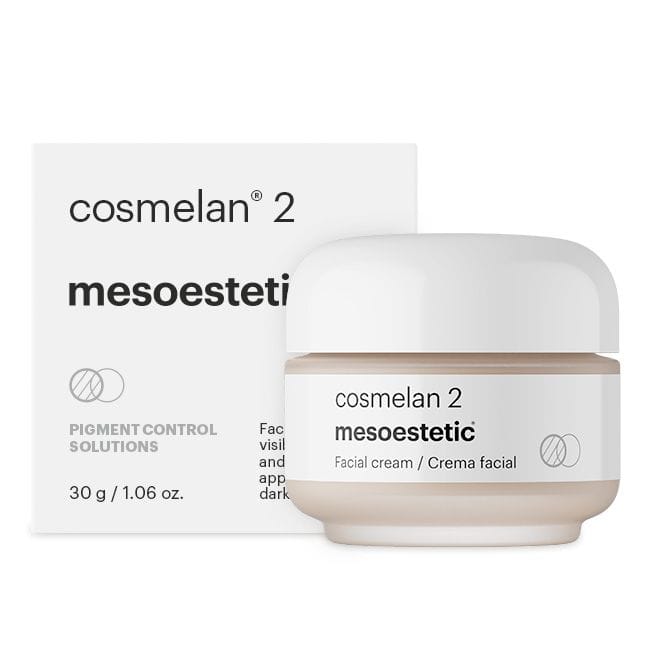
Mesoestetic® Cosmelan
Order Mesoestetic® Cosmelan for Clinics
Depigmenting And Illuminating Fluid Cream
$199.00
You save
Description
Mesoestetic® Cosmelan is a professional depigmenting treatment system used in clinic-directed pigmentation protocols. Licensed clinics, med spas, dermatology practices, and healthcare professionals can order Mesoestetic Cosmelan online for treatment-room use and structured take-home maintenance. The practical value is its two-phase workflow: an in-clinic mask phase followed by a maintenance cream phase that helps standardize staff education, follow-up, and adherence.
The system is commonly discussed as a Cosmelan peel or Cosmelan depigmenting treatment because it is designed for visible uneven tone, melasma-pattern discoloration, photodamage-related dark spots, and post-inflammatory discoloration when appropriate for the individual under professional care. It should be integrated into a broader skin assessment, sun-protection plan, and barrier-support routine rather than treated as a standalone cosmetic shortcut.
Mesoestetic Cosmelan Price, Pack Planning, and Clinic Ordering
Clinics can sign in to view the current Mesoestetic Cosmelan price and pack availability for professional purchasing. Contract and volume tiers may be available for qualified facilities, which helps practices align inventory with planned pigmentation programs, consultation volume, and follow-up schedules. Because pigmentation protocols require continuity, ordering should account for both the initial mask appointment and the maintenance period that follows.
The Cosmelan pack is used operationally as a treatment sequence rather than a single casual skincare item. The in-clinic component anchors the service visit, while Cosmelan 2 supports the ongoing maintenance window between reviews. This structure helps coordinators schedule the procedure, staff provide consistent instructions, and clinicians document tolerance and progress at defined intervals.
For broader room setup, clinics may browse professional peels and masks used in aesthetic treatment planning. Pigment-focused programs often require careful sequencing, so keep peel frequency, sun exposure risk, skin barrier status, and seasonal timing in the same planning conversation as product purchasing.
What Mesoestetic Cosmelan Is and How It Works
Mesoestetic Cosmelan is a two-phase topical depigmentation method intended for professional oversight. The first phase is the application of Cosmelan 1 in a clinic setting by trained personnel. The second phase uses Cosmelan 2 as home maintenance to continue pigment-control support after the mask stage.
The protocol targets excess melanin activity. Melanin is the pigment that gives skin its color, and irregular overproduction can appear as dark patches, mottled tone, or localized spots. Cosmelan uses depigmenting agents, including tyrosinase-inhibiting activity, to help reduce the visible appearance of acquired pigmentation and support a more even tone over time.
Professional assessment remains central because pigmentation is not one uniform condition. Melasma, sun-related lentigines, post-inflammatory hyperpigmentation, and mixed patterns can respond differently. Teams should evaluate skin phototype, recent procedures, current topical products, pregnancy or lactation status when relevant to practice policy, sensitivity history, and the patient’s ability to follow strict sun-care instructions.
Why it matters: A standardized protocol is easier to document, teach, and adjust than an improvised mix of unrelated brightening products.
Professional Applications in Pigmentation Programs
Many aesthetic and dermatology practices use Cosmelan within treatment plans for visible hyperpigmentation, uneven skin tone, melasma-pattern discoloration, photodamage, and post-inflammatory dark marks. It can fit into noninvasive clinic pathways because the route is topical and the service can be scheduled around intake, application, post-procedure instructions, and maintenance follow-up.
Cosmelan should not be positioned as removing every form of pigmentation. Pigment depth, trigger factors, hormonal influence, ultraviolet exposure, inflammation, medication history, and adherence can all affect outcomes. Clinicians should set expectations that pigment control usually requires maintenance, photoprotection, and avoidance of avoidable irritation.
Practices that build year-round pigment services may combine Cosmelan planning with compatible brightening products, calming skincare, and strict sunscreen counseling. Adjacent daily-care options can be reviewed within professional skincare, while treatment-room and retail-support products in creams and serums may help clinics build a coherent protocol menu.
Cosmelan 1 and Cosmelan 2 Workflow
The Cosmelan 1 phase is performed in clinic. Staff should prepare the skin according to manufacturer guidance and the practice’s protocols, apply the mask under professional supervision, and provide clear removal and aftercare instructions. The exact time the mask remains on the skin should be determined by the clinician and manufacturer instructions, taking into account phototype, sensitivity, treatment goal, and prior skin response.
Cosmelan 2 is used during the maintenance stage to reinforce pigment-control efforts after the in-clinic mask. This handoff is operationally important: the patient leaves with a defined routine rather than a vague recommendation to use brightening skincare. Teams can schedule early check-ins to evaluate dryness, peeling, redness, sensitivity, and adherence to sun avoidance.
Because pigmentation protocols can be disrupted by irritation, the maintenance phase should be kept simple. Avoid layering multiple aggressive exfoliants or actives unless the clinician has intentionally designed that regimen. Supportive moisturization and broad-spectrum sun protection are often more important than adding more steps.
Key Features for Clinic Use
- Two-phase professional protocol with an in-clinic mask and home maintenance cream.
- Topical route that fits noninvasive aesthetic and dermatology workflows.
- Designed for visible acquired pigmentation concerns under professional oversight.
- Cosmelan 2 maintenance supports continuity between clinic reviews.
- Protocol structure helps standardize consultation, consent, instructions, and follow-up.
- Useful for practices building pigment-focused treatment menus.
- Manufacturer packaging provides product identification, lot, and expiry visibility.
- Shelf-stable storage should follow the manufacturer’s label directions.
- Pairs with barrier-support and sun-protection counseling in professional routines.
- Suitable planning item for multi-room clinics that need consistent setup.
Safety, Tolerance, and Contraindication Screening
Cosmelan treatment can cause expected local skin responses, especially during the early adjustment period. Temporary redness, dryness, flaking, peeling, tightness, warmth, or sensitivity may occur. These effects should be explained before treatment so staff can distinguish expected downtime from symptoms that require clinical reassessment.
Do not apply the mask to skin with active infection, open wounds, severe inflammatory dermatoses, or areas where the barrier is significantly compromised. Practices should also screen for recent aggressive resurfacing, topical sensitizers, photosensitizing routines, active dermatitis, and a history of poor tolerance to depigmenting or exfoliating products. When uncertain, delay treatment until the clinician has reviewed suitability.
Sun exposure is a major practical risk in pigmentation programs. Unprotected ultraviolet exposure can worsen discoloration and undermine maintenance. Clinics should document sunscreen counseling, reinforce avoidance of tanning, and remind patients that pigment control is an ongoing process rather than a one-visit endpoint.
Escalate concerns to the supervising clinician if irritation is intense, prolonged, spreading, or associated with swelling, blistering, crusting, or signs of infection. Maintenance routines may need to be paused, simplified, or adjusted based on clinical judgment.
Composition and Ingredient Review
The Cosmelan line uses a proprietary depigmenting complex with ingredients selected to influence melanin formation and support visible tone uniformity. Tyrosinase-inhibiting activity is central to the pigment-control concept because tyrosinase is involved in melanin production. Supportive excipients help the product spread and remain usable within a structured topical routine.
Full ingredient information and active details should be reviewed on the manufacturer’s packaging and inserts before use. Ingredient review is especially important for patients with topical allergies, fragrance sensitivity, eczema-prone skin, recent procedures, or complex at-home routines. Document any exclusions or modifications according to the clinic’s policy.
For practices comparing Mesoestetic brand options, Mesoestetic products can help teams evaluate adjacent protocols within the same professional skincare family. Brand consistency can simplify staff education, but product choice should still reflect the treatment goal and tolerance profile.
Packaging, Storage, and Handling
Mesoestetic Cosmelan is supplied for professional use as a structured treatment system. Components arrive in sealed manufacturer packaging with labeling for identification, lot number, and expiry date review. Staff should verify the pack before scheduling treatment-room use, especially when multiple pigmentation products are stored in the same area.
Store the product in a cool, dry place away from direct heat and light, following the manufacturer’s label. Inventory teams should rotate stock by expiry date and keep treatment-room products separated from general retail skincare when clinic policy requires it. This helps reduce mix-ups and supports cleaner documentation.
Orders are supported by temperature-controlled handling when required and tracked US delivery. If a clinic is planning a block of pigment services, align ordering with consultation dates, treatment-room availability, and the expected maintenance handoff so the protocol is not interrupted.
Documentation and Staff Workflow
Cosmelan works best in clinics that treat it as a protocol rather than a single product sale. Intake should capture pigment history, prior procedures, sun exposure habits, current skincare, sensitivity patterns, and treatment goals. Photographs, consent, and baseline notes can support continuity when more than one provider participates in care.
Staff training should cover preparation steps, application boundaries, patient instructions, maintenance timing, expected reactions, and escalation triggers. Front-desk teams also need enough protocol knowledge to schedule realistic follow-up visits and avoid booking conflicting treatments too close together.
Quick tip: Keep a standard Cosmelan handoff checklist so every patient receives the same core aftercare points.
Comparable and Adjacent Pigment Products
Clinics building a wider depigmentation menu may review Mesoestetic Melan Tran as an adjacent option within pigment-focused care. It may be considered when teams want complementary support, but timing and combination decisions should remain under professional direction.
Daily photoprotection and pigment-care products may also support treatment plans. Azelac RU Depigmenting Luminous Fluid Cream SPF50 is a related skincare option that combines pigment-care positioning with sun protection. Product selection should account for skin type, sensitivity, and the primary regimen already in use.
For localized dark-spot routines, clinics may compare Mela 360 Spot Corrector Serum. Practices that use chemical peel pathways alongside pigment services can also evaluate Melases TRX TCA 10 Peel for appropriately selected professional protocols.
Availability and Substitutions
Mesoestetic Cosmelan is ordered as a professional clinic supply, and purchasing teams should plan around service demand and follow-up cadence. If your practice uses a standardized Cosmelan peel pack across rooms, maintain clear inventory notes so providers know which pack is allocated to each scheduled protocol.
If a substitution is being considered, keep it within the clinical lead’s review. Pigment products can differ in intensity, mechanism, downtime, and maintenance requirements. A substitute should not be treated as interchangeable unless the practice has reviewed the protocol, patient instructions, and safety profile.
Authoritative Sources
- Manufacturer Cosmelan professional treatment information
- American Academy of Dermatology melasma overview
Ready to equip your pigmentation protocol? Sign in to order Mesoestetic® Cosmelan for your licensed clinic with professional supply documentation and US distribution support.
This content is for informational purposes only and is not a substitute for professional medical advice.
Frequently Asked Questions
What is Mesoestetic Cosmelan used for in clinics?
Mesoestetic Cosmelan is used in professional pigmentation protocols to help improve the visible appearance of uneven tone, melasma-pattern discoloration, photodamage-related spots, and post-inflammatory discoloration when appropriate after clinical assessment.
How long should the Cosmelan peel stay on the skin?
The mask time should follow the manufacturer’s instructions and the supervising clinician’s protocol. Timing may vary with skin phototype, sensitivity, treatment goal, and prior skin response, so it should not be treated as a universal fixed interval.
Does Cosmelan remove all pigmentation?
No professional pigment treatment can guarantee removal of all pigmentation. Results depend on pigment type, depth, triggers, sun exposure, inflammation, adherence to maintenance, and the clinic’s follow-up plan.
How should clinics plan Cosmelan pack inventory?
Plan inventory around scheduled mask appointments and the maintenance phase that follows. Confirm sealed packaging, lot details, expiry dates, and pack allocation before treatment-room use to avoid interruption in the protocol.
Can Cosmelan be combined with other peels or brightening products?
Combination use should be directed by the clinical lead. Other peels, exfoliants, retinoids, or brightening products may increase irritation if layered too aggressively, so sequencing and barrier support should be documented.
What reactions should staff discuss before treatment?
Staff should discuss temporary redness, dryness, peeling, tightness, warmth, and sensitivity. More severe or persistent irritation, swelling, blistering, crusting, or signs of infection should be escalated to the supervising clinician.
Specifications
- Main Ingredient: Salicylic Acid, Azelaic Acid, Kojic Acid
- Manufacturer: Mesoestetic
- Drug Class: Depigmenting And Illuminating Fluid Cream
- Generic Name: Salicylic Acid, Kojic Acid, Azelaic Acid
- Package Contents: 30 g
- Storage Requirements: Room Temperature (2℃~25℃)
- Main Usage: Skin Pigmentation
Here to help
Questions about ordering, delivery or products? You can email our team here or call now at 1-800-630-9757 and be connected with your dedicated Account Manager
Related Products
Prolia® (International English)
Prescription Medication
$529.00 - $549.00
You save
You save
Evenity® (English Alternative)
Injectable Medication
$1,229.00 - $1,299.00
You save
You save
Intraline® For Men
Dermal Filler
$59.00 - $79.00
You save
You save
RejuvaNAD+ Pro
Injectable Medication
$237.00 - $249.00
You save
You save
Related Articles
Prednisone in Clinical Care: Uses, Risks, and Monitoring
Prednisone is a prescription systemic corticosteroid used to reduce inflammation or suppress immune activity in…
Lip Fillers Swelling Stages: Timeline, Safety, and Follow-Up
Lip fillers swelling stages usually follow a short inflammatory course: swelling appears soon after injection,…
Hypopigmentation of the Skin: Assessment and Care
Hypopigmentation of the skin means one or more areas look lighter than the surrounding skin.…
Radiesse vs Sculptra: Selection Factors for Clinics
Radiesse vs Sculptra is best understood as a comparison between two collagen-stimulating injectables with different…
Hyaluronic Acid Under-Eye Filler: Safety and Workflow
Hyaluronic acid under-eye filler is an injectable soft-tissue filler used by trained aesthetic clinicians to…
Dermal Filler Types: Materials, Uses, and Clinic Fit
Dermal filler types are usually grouped by their base material, tissue behavior, and expected role…
What Is Dysport? Clinical Uses, Safety, and Workflow
For clinic teams asking what is Dysport, the short answer is simple: Dysport is a…
Biostimulators in Aesthetic Care: Selection and Safety
Biostimulators are injectable aesthetic products used to encourage a controlled tissue response, often involving new…