
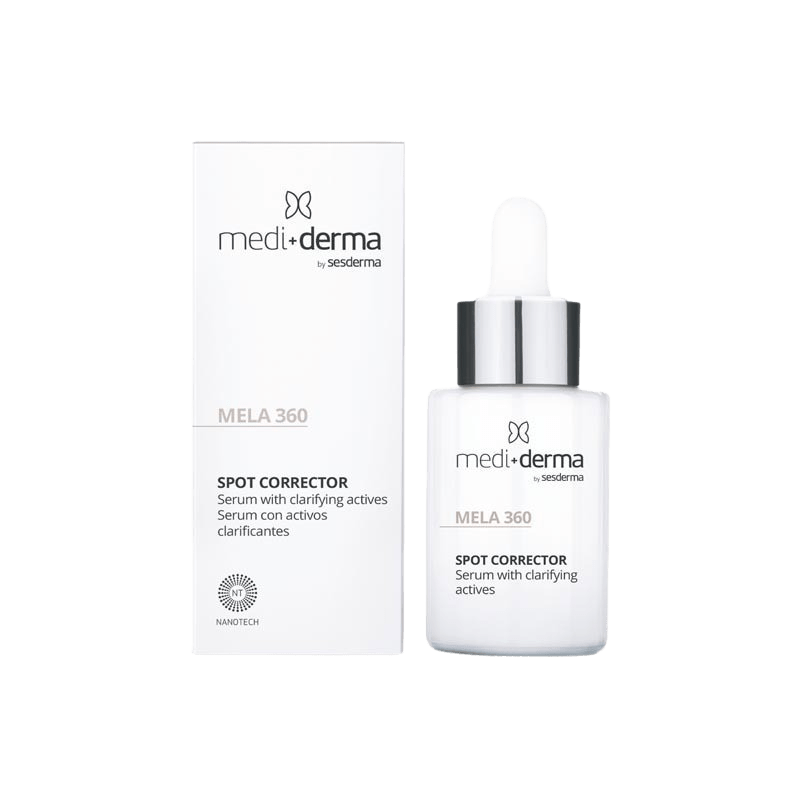
MEDIDERMA® MELA 360 SPOT CORRECTOR SERUM
Order MEDIDERMA® MELA 360 Spot Corrector Serum for Clinics
Spot Corrector Serum
$59.00
You save
Description
MEDIDERMA® MELA 360 SPOT CORRECTOR SERUM is a professional 30 mL topical serum for clinic pigment-care routines targeting the look of dark spots, uneven tone, and dull skin. Licensed clinics, med spas, aesthetic practices, and healthcare professionals can order the serum for supervised use in treatment-room workflows, retail home-care programs, or maintenance protocols. The key operational detail is protocol control: staff should align serum use with sunscreen counseling, irritation monitoring, and documented product sequencing.
The MELA 360 Spot Corrector Serum is intended for external use on intact skin. Clinics commonly evaluate it for cosmetic hyperpigmentation support, including visible blotchiness, melasma-like discoloration, lentigines, freckles, post-inflammatory marks, and uneven tone. It should not replace clinical assessment of changing lesions, inflammatory skin disease, or pigment changes that need medical diagnosis.
Why it matters: Pigment routines are easier to supervise when brightening products, photoprotection, and procedure timing are planned together.
Clinic Ordering, Price, and Professional Fit
MEDIDERMA MELA 360 Spot Corrector Serum 30ml is offered for professional purchasing by facilities that manage skincare inventory under a clinic protocol. Current Mediderma MELA 360 price details can vary by account status, quantity, and catalog conditions, so procurement teams should view the live ordering area and match the unit to internal demand. The serum is best evaluated as part of a structured pigment-care assortment rather than as a stand-alone cosmetic promise.
For clinic teams, the ordering decision usually depends on three practical factors: whether the 30 mL dropper format suits staff demonstrations and retail kits, whether the ingredient profile fits the clinic’s pigment pathway, and whether staff can document counseling on sun exposure and irritation. Facilities that already use Mediderma products may want to review the broader Mediderma range when standardizing product families across treatment rooms and home-care shelves.
- Facility use: professional aesthetic routines and supervised cosmetic pigment care.
- Unit size: 30 mL dropper bottle for external topical use.
- Protocol role: targeted tone support, dark-spot care, and maintenance between visits.
- Records: document lot, expiry, product placement, and counseling notes.
- Procurement reference: use SKU 89891 for internal inventory coordination.
This serum is not described as a prescription medicine in the supplied product information. Professional facilities should still follow local sale, delegation, and documentation requirements for cosmetic products used within aesthetic services or recommended home-care regimens.
What the Serum Is Used For in Pigment Protocols
MEDIDERMA® MELA 360 SPOT CORRECTOR SERUM is a Mediderma dark spot corrector serum from the MELA 360 line. It is positioned for cosmetic brightening and visible tone improvement in skin with dullness, localized discoloration, and uneven pigment appearance. Hyperpigmentation means excess visible pigment in the skin; melasma describes brown-gray facial patches that can fluctuate with sun exposure and hormonal triggers.
In practice, clinics may place the serum within pre-procedure conditioning, post-procedure maintenance, or non-procedure pigment-care plans. The product may be relevant for patients receiving peels, resurfacing services, or skincare programs where staff need a targeted serum that can be sequenced with cleanser, moisturizer, and daily photoprotection. For teams building broader professional skincare shelves, the creams and serums category and skincare catalog can support adjacent assortment planning.
The serum should not be positioned as the highest rated dark spot remover for every skin type or pigment concern. Ratings and reviews can help clinics understand product experience, but they do not replace ingredient review, tolerance screening, and provider judgment. A responsible protocol separates cosmetic discoloration goals from atypical, painful, bleeding, rapidly changing, or medically concerning lesions that require assessment before routine skincare recommendations.
Forms, Packaging, and Inventory Details
MEDIDERMA® MELA 360 SPOT CORRECTOR SERUM is supplied as a 30 mL topical serum in a dropper bottle. The format supports controlled dispensing during staff demonstrations and can fit supervised home-care kits when the clinic’s protocol includes a leave-on brightening step. No pharmaceutical strength is stated for this cosmetic serum, so the current carton and insert should remain the controlling sources for directions and ingredient confirmation.
| Attribute | Clinic Detail |
|---|---|
| Product name | MEDIDERMA® MELA 360 SPOT CORRECTOR SERUM |
| Product form | Topical serum for external use on intact skin |
| Unit size | 30 mL dropper bottle |
| Packaging | Retail carton with product information |
| Inventory reference | SKU 89891 |
| Common clinic role | Cosmetic dark-spot support and tone-maintenance routines |
At receiving, staff should compare the unit against purchase records, record lot and expiry information, and keep retail units separate from backbar testers. A compact bottle can move easily between treatment rooms, consultation spaces, and retail shelves, so location tracking helps prevent recordkeeping errors. If the bottle, carton, seal, or label appears damaged or inconsistent, quarantine the unit before use.
Mediderma Mela 360 Ingredients and Formula Notes
Mediderma Mela 360 ingredients are commonly associated with tranexamic acid, vitamin C, niacinamide, and phytic acid. Clinics often evaluate this combination because it brings together tone-supporting, antioxidant, barrier-support, and gentle brightening components in one serum. Ingredient lists can change, so staff should use the current carton and insert when training personnel, building kits, or answering patient questions.
- Tranexamic acid: used in cosmetic pigment routines for uneven-looking tone.
- Vitamin C: provides antioxidant support associated with brighter-looking skin.
- Niacinamide: supports barrier function and visible blotchiness management.
- Phytic acid: contributes gentle chelating and tone-brightening support.
The manufacturer positions the MELA 360 line as a liposomal pigment-care range, which is why clinics may refer to this item as a MELA 360 liposomal serum. Liposomal delivery claims should be interpreted through the manufacturer’s instructions and the clinic’s experience with tolerability, not as a reason to increase frequency or combine aggressive actives without supervision. For staff education on antioxidant selection in topical routines, the article on skincare products for healthy-looking skin may help place antioxidant serums within broader cosmetic planning.
How Clinics Use It in Treatment-Room Workflows
Use should follow the product insert and the supervising provider’s protocol. The Mediderma spot corrector serum is typically placed after cleansing and before moisturizer or photoprotection when that order is part of the clinic routine. Staff should avoid patient-specific frequency changes unless the protocol owner has authorized those instructions.
For pre-procedure routines, the serum may be considered when a clinic wants to support tone uniformity before a peel or other aesthetic service. For maintenance routines, it may help keep pigment-care plans consistent between scheduled visits. When staff build regimens around exfoliation, the article on chemical peels for hyperpigmentation can support internal education about procedure timing and pigment expectations.
- Preconditioning: consider tolerance before procedures when the protocol allows.
- Maintenance: keep tone-care steps consistent between clinic appointments.
- SPF alignment: reinforce daily photoprotection in every pigment program.
- Procedure spacing: avoid unnecessary overlap with aggressive exfoliation windows.
- Staff notes: document product sequence, counseling points, and reported reactions.
Quick tip: Keep a written pigment-care sequence in each treatment room so staff give consistent instructions.
Storage, Handling, and US Delivery Logistics
Store and handle the serum according to the current carton and insert. In routine clinic operations, that means keeping the bottle capped, limiting unnecessary heat and light exposure, and preventing contact between the dropper tip and skin, gloves, counters, towels, or treatment tools. Dropper hygiene is especially important when staff demonstrate use repeatedly.
Facilities should separate unopened retail inventory from tester units and backbar products. Testers should be labeled clearly, replaced according to clinic policy, and excluded from retail sale or take-home kits. When staff transfer units between rooms or retail displays, the movement should be reflected in inventory records so lot and expiry data remain traceable.
MedWholesaleSupplies supports professional clinic ordering with brand-name medical and aesthetic products sourced through vetted distributors and verified supply channels. Completed facility purchases are handled with temperature-controlled handling when required and tracked US delivery.
Contraindications, Warnings, and Screening
Do not use this serum on broken, infected, actively inflamed, or severely irritated skin. Known sensitivity to any listed ingredient should be treated as a reason to avoid use unless the supervising clinician determines otherwise. Screening should include recent peels, laser or energy-based procedures, retinoid escalation, active dermatitis, allergy history, and products already used at home.
Melasma, lentigines, freckles, and post-inflammatory discoloration can recur or fluctuate, particularly with ultraviolet exposure. Daily photoprotection should be presented as a core part of the regimen, not an optional add-on. Patients with changing, painful, bleeding, crusting, or atypical pigmented lesions should be directed for medical assessment before a cosmetic pigment routine is started or continued.
Staff should document visible baseline concerns, products used concurrently, counseling provided, and any tolerability issues reported after introduction. This helps the clinic distinguish expected mild adjustment from reactions that require stopping the product or modifying the regimen under professional supervision.
Adverse Effects, Interactions, and Monitoring
Common cosmetic tolerability issues may include mild stinging, redness, dryness, tightness, or transient flaking. These effects may be more likely when the MELA 360 dark spot serum is layered with exfoliating acids, retinoids, benzoyl peroxide, hydroquinone-containing regimens, or recent resurfacing procedures. Staff should capture onset, duration, severity, concurrent products, and steps authorized by the protocol owner.
More concerning reactions include swelling, hives, blistering, marked burning, eye exposure with persistent discomfort, or worsening irritation that does not improve after stopping use. If these occur, discontinue application and follow the clinic’s adverse-event procedure. Escalation to an appropriate healthcare professional is important when symptoms are severe, spreading, or associated with systemic signs.
Formal drug-interaction tables are not usually applied to cosmetic topical serums as they are to systemic medicines. Practical product overlap still matters. Retinoids, alpha hydroxy acids, beta hydroxy acids, strong vitamin C products, peels, and other brightening products can increase irritation risk when introduced too quickly or layered without clear sequencing.
How It Compares With Related Brightening Products
MELA 360 depigmenting serum is best compared by ingredient profile, texture, procedure timing, and the level of staff monitoring required. It should not be treated as interchangeable with every dark-spot product. A clinic may select one product for pre-peel preparation, another for daytime SPF-supported routines, and another for patients who need a gentler barrier-focused approach.
| Option | How Clinics May Evaluate It |
|---|---|
| MEDIDERMA® MELA 360 SPOT CORRECTOR SERUM | 30 mL targeted serum associated with tranexamic acid, vitamin C, niacinamide, and phytic acid. |
| Azelac Ru Liposomal Serum | Another liposomal brightening serum to evaluate by active profile and protocol placement. |
| Azelac Ru Depigmenting Luminous Fluid Cream SPF50 | A pigment-support product with SPF positioning for routines where daytime photoprotection is central. |
| C-Defence MD Cskin Concentrate Serum | A Mediderma antioxidant serum to consider when vitamin C support is a primary protocol goal. |
Clinics that carry several pigment-care lines should use consistent language at consultation, checkout, and follow-up. Product choice should reflect skin tolerance, the planned procedure series, the patient’s current routine, and the clinic’s ability to monitor irritation and photoprotection adherence.
Mediderma, Sesderma, and Brand Context
Clinics sometimes ask whether Sesderma and Mediderma are the same because both names appear in professional skincare discussions. They are related Spanish skincare brands within the same broader professional ecosystem, but product selection should still be made by the specific label, line, active ingredients, and protocol role. A Mediderma serum should not be substituted with a different Sesderma or Mediderma product without reviewing the product directions and intended use.
For broader background on Mediderma’s professional skincare positioning, the article on Mediderma skin care benefits may help staff understand where the brand fits in aesthetic practice. Clinic teams using peels can also review Mediderma peel products when mapping brightening serums around exfoliating services.
Substitution and Inventory Planning
If MEDIDERMA® MELA 360 SPOT CORRECTOR SERUM is not on hand in the needed quantity, substitutions should be approved by the clinician or manager responsible for the pigment protocol. A suitable substitute should match the intended cosmetic role, not only the broad category name. Ingredient overlap, irritation potential, product texture, SPF expectations, and patient instructions all need review before a change is made.
Inventory planning should account for seasonal demand. Pigment-care interest often increases around peel programs, post-summer discoloration visits, and maintenance campaigns. Keep substitution notes specific enough that front-desk, treatment, and retail staff use the same terminology when discussing the regimen.
Clinics may also track product feedback during follow-up visits, including texture acceptance, adherence barriers, irritation reports, and sunscreen consistency. Reviews can inform stocking decisions, but they should be interpreted alongside professional observation and the clinic’s safety documentation.
Authoritative Sources
The following sources support manufacturer and ingredient context. They do not replace the current product insert, carton, or clinic policy.
- Manufacturer product information is available from Mediderma MELA 360 Spot Corrector.
- Vitamin C background is summarized by the NIH Office of Dietary Supplements.
This content is for informational purposes only and is not a substitute for professional medical advice.
Frequently Asked Questions
What are the ingredients in Mediderma Mela 360 Spot Corrector Serum?
The formula is commonly associated with tranexamic acid, vitamin C, niacinamide, and phytic acid. Clinics should use the current carton and insert as the controlling source because cosmetic ingredient lists can change.
Can clinics use MELA 360 Spot Corrector Serum after peels or resurfacing procedures?
It may fit some maintenance or pigment-care protocols, but timing should be set by the supervising provider. Staff should avoid layering it too soon with aggressive exfoliation, retinoids, or recent resurfacing if irritation risk is high.
Is MEDIDERMA MELA 360 Spot Corrector Serum a prescription product?
The supplied product information does not describe this topical cosmetic serum as a prescription medicine. Professional facilities should still follow their local documentation, sale, and delegation rules for aesthetic skincare products.
How should clinics store and handle the 30 mL dropper bottle?
Store it according to the carton and insert, keep the bottle capped, limit unnecessary heat and light exposure, and avoid touching the dropper tip to skin, gloves, counters, or tools. Record lot and expiry details at receiving.
How does MELA 360 Spot Corrector Serum compare with other dark spot products?
Compare it by active ingredients, texture, procedure timing, SPF expectations, and patient tolerance. It should not be treated as interchangeable with another pigment-care serum unless the protocol owner reviews the label and intended role.
Specifications
- Main Ingredient: Tranexamic Acid, Niacinamide, Phytic Acid, Vitamin C
- Manufacturer: Mediderma Laboratories
- Drug Class: Topical Spot Corrector
- Generic Name: Tranexamic Acid, Vitamin C, Niacinamide, and Phytic acid.
- Package Contents: 50 ML
- Storage Requirements: Room Temperature (2℃~25℃)
- Main Usage: Skin Pigmentation
About the Brand
Mediderma
BUY MEDIDERMA PRODUCTS ONLINE AT WHOLESALE PRICES ON MedWholesaleSupplies Mediderma is a reliable brand within the medical sector, delivering top-of-the-line skincare products. These can now be conveniently procured directly from our online platform, medwholesalesupplies.com. Buy MEDIDERMA® skincare products at wholesale prices – register an account on Med Wholesale Supplies today! What is MediDerma? Mediderma's commitment to research and invention ensures that their offerings cater effectively and safely to diverse dermatological needs. Whether you're a medical professional or an individual seeking superior skincare options, Mediderma stands as the brand of choice. MEDIDERMA® Product Range By availing Mediderma's range on medwholesalesupplies.com, we make it easy for you to access world-class skincare solutions without any hassles. As a highly-reputed online medical store, we offer a broad gamut of medical offerings, including Mediderma, satisfying an array of customer requirements. Our focus is consistently on customer satisfaction which is reflected in our competitive pricing, timely delivery, and unmatched customer assistance. With medwholesalesupplies.com, buying Mediderma skincare products is a breeze. ARGIPEEL Exfoliant gel for sensitive skin; contains arginine for hydration, antioxidant effects, and collagen stimulation, plus lactic acid for gentle exfoliation. AZELAC Skin-brightening line for inflamed, hypersensitive skin and rosacea; includes creams, serums, and peels for redness, swelling, hyperpigmentation, inflammation, and acne. C-DEFENSE Vitamin C and peptide-based products for tired, dull skin; brightens, firms, and protects against pollution and free radicals. FERULAC Anti-aging line with ferulic acid, vitamins, and retinoids; targets wrinkles, fine lines, and sun damage, stimulating collagen production. FR-ANTIOX Ferulic acid-based line with additional antioxidants; combats oxidative stress, sun damage, and aging, suitable for mature skin. HYLANSES Products with various types of hyaluronic acid; hydrates and addresses firmness and elasticity, ideal for sensitive, dry, and mature skin. MELA 360 Targets hyperpigmentation with products like the MELA 360 SPOT CORRECTOR; contains kojic acid, arbutin, and licorice extract for brightening dark spots. MELASES TRX Focuses on melasma and hormonal dark spots; tranexamic acid chemical peel reduces sun damage, inflammation, and aging effects. Where Can I Buy MEDIDERMA®? MEDIDERMA® Laboratories offer a wide range of products tailored to various patient needs. If you wish to order MEDIDERMA® online, our team can assist you in finding the best deals. Dermatological clinics should purchase MEDIDERMA® at wholesale prices to offer their patients the most affordable rates while ensuring product authenticity and quality. Contact our agents today to supply your clinic with genuine MEDIDERMA® products from trusted distributors.
Browse Mediderma Products
Here to help
Questions about ordering, delivery or products? You can email our team here or call now at 1-800-630-9757 and be connected with your dedicated Account Manager
Related Products
Prolia® (International English)
Prescription Medication
$529.00 - $549.00
You save
You save
Evenity® (English Alternative)
Injectable Medication
$1,229.00 - $1,299.00
You save
You save
Intraline® For Men
Dermal Filler
$59.00 - $79.00
You save
You save
RejuvaNAD+ Pro
Injectable Medication
$237.00 - $249.00
You save
You save
Related Articles
Prednisone in Clinical Care: Uses, Risks, and Monitoring
Prednisone is a prescription systemic corticosteroid used to reduce inflammation or suppress immune activity in…
Lip Fillers Swelling Stages: Timeline, Safety, and Follow-Up
Lip fillers swelling stages usually follow a short inflammatory course: swelling appears soon after injection,…
Hypopigmentation of the Skin: Assessment and Care
Hypopigmentation of the skin means one or more areas look lighter than the surrounding skin.…
Radiesse vs Sculptra: Selection Factors for Clinics
Radiesse vs Sculptra is best understood as a comparison between two collagen-stimulating injectables with different…
Hyaluronic Acid Under-Eye Filler: Safety and Workflow
Hyaluronic acid under-eye filler is an injectable soft-tissue filler used by trained aesthetic clinicians to…
Dermal Filler Types: Materials, Uses, and Clinic Fit
Dermal filler types are usually grouped by their base material, tissue behavior, and expected role…
What Is Dysport? Clinical Uses, Safety, and Workflow
For clinic teams asking what is Dysport, the short answer is simple: Dysport is a…
Biostimulators in Aesthetic Care: Selection and Safety
Biostimulators are injectable aesthetic products used to encourage a controlled tissue response, often involving new…