
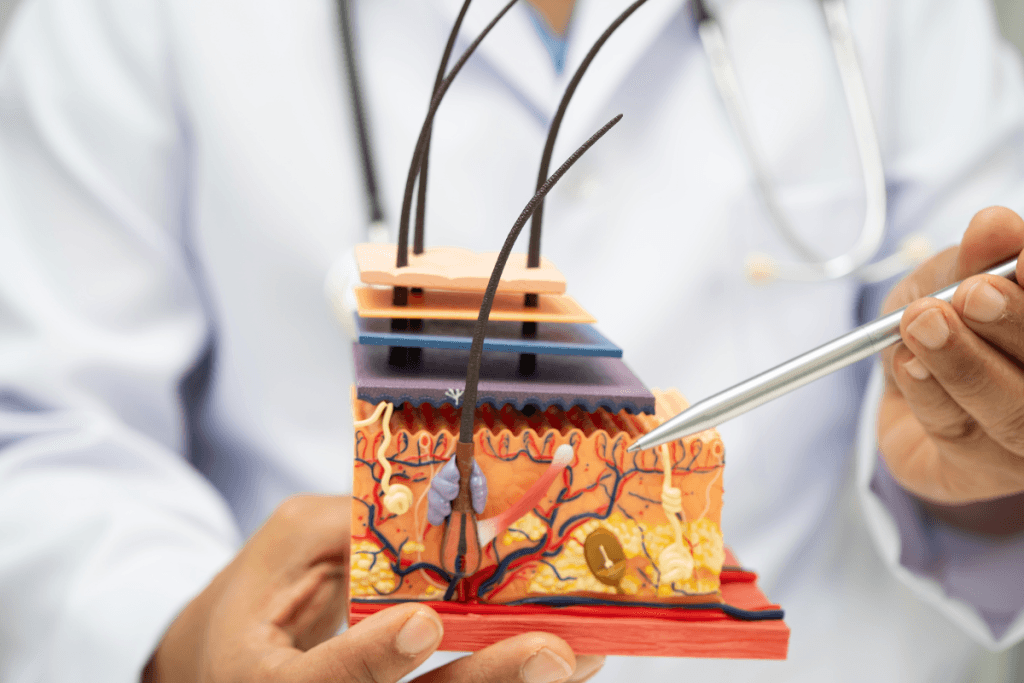
The epidermis has four main layers in most body sites: stratum basale, stratum spinosum, stratum granulosum, and stratum corneum. Thick skin on the palms and soles adds a fifth layer, the stratum lucidum. For clinicians asking what are the layers of the epidermis, the practical value is depth awareness: the epidermis is the outer, avascular barrier, while vascular, collagen-rich support sits deeper in the dermis.
Key Takeaways
- Layer order matters: Cells mature from basale to corneum.
- Thick skin differs: Palms and soles include stratum lucidum.
- Barrier function is surface-led: Corneocytes and lipids control permeability.
- Redness is often deeper: Vascular findings usually involve the dermis.
- Charting should be precise: Use epidermal, dermal, and subcutaneous language.
Epidermis Anatomy in Clinical Context
The epidermis is the outermost compartment of skin and forms a stratified squamous epithelium. It is made mostly of keratinocytes, the cells that produce keratin and move upward as they mature. This layered design helps explain surface scale, fissuring, irritation, pigment distribution, and permeability.
Unlike the dermis, the epidermis has no blood vessels. Nutrients and oxygen diffuse upward from the dermal side, across the basement membrane zone. That anatomy matters when staff describe wounds, superficial erosions, adhesive injury, or post-procedure surface change. A finding may look superficial, but erythema, edema, bruising, or nodularity can involve deeper tissue planes.
The main resident cells include keratinocytes, melanocytes, Langerhans cells, and Merkel cells. Melanocytes are pigment-producing cells found mainly in the basal layer. Langerhans cells are antigen-presenting immune cells that support cutaneous immune surveillance. Merkel cells contribute to light-touch sensation in specialized skin sites.
Why it matters: A shared anatomy vocabulary reduces ambiguity in notes, consent discussions, and training materials.
What Are the Layers of the Epidermis in Order?
From deep to superficial, the epidermal layers are stratum basale, stratum spinosum, stratum granulosum, stratum lucidum in thick skin, and stratum corneum. From the surface downward, the order reverses: stratum corneum, stratum lucidum in thick skin, stratum granulosum, stratum spinosum, and stratum basale.
The distinction between thin and thick skin is important. Most of the body has thin skin, which commonly shows four epidermal layers. Thick skin is found on high-friction acral sites, especially palms and soles. It has a more prominent stratum corneum and a distinct stratum lucidum.
For a deeper sequence-focused review, clinic educators can pair this overview with Layers Of The Epidermis In Order. That type of companion reference can help staff keep superficial-to-deep and deep-to-superficial descriptions consistent.
| Layer | Plain-language cue | Key features | Clinical relevance |
|---|---|---|---|
| Stratum basale | Growth layer | Mitotic keratinocytes, melanocytes, basement membrane attachment | Reference point for regeneration and pigment patterns |
| Stratum spinosum | Spiny cell layer | Desmosomes, early keratin bundles, immune surveillance | Common context for spongiosis in eczematous processes |
| Stratum granulosum | Granule layer | Keratohyalin granules and lipid processing | Important for barrier assembly and irritant resistance |
| Stratum lucidum | Clear layer | Compact translucent zone in thick skin | Relevant to acral friction tolerance and callus context |
| Stratum corneum | Outer dead-cell layer | Corneocytes within a lipid matrix | Major determinant of topical permeability and surface hydration |
What Are the Five Layers of the Epidermis?
The five-layer model applies best to thick skin. In that model, the layers are stratum basale, stratum spinosum, stratum granulosum, stratum lucidum, and stratum corneum. Teaching materials often use this model because it is complete and memorable.
In clinic documentation, avoid applying the five-layer model to every body site. If a template lists all five layers, a short note can clarify that a distinct lucidum is mainly a thick-skin feature. This prevents overgeneralization when staff discuss facial, trunk, or extremity skin.
What Is the Second Layer of the Epidermis?
The answer depends on direction. From deep to superficial, the second layer is the stratum spinosum. From the surface downward, the second layer is the stratum lucidum in thick skin, or the stratum granulosum in most thin-skin sites.
This directional issue is a common source of training confusion. A quick fix is to state the direction every time: “deep to superficial” or “superficial to deep.” That small addition makes diagrams and procedure notes easier to interpret.
Layer-by-Layer Functions From Basale to Corneum
Each epidermal layer represents a stage of keratinocyte differentiation. Cells begin near the basement membrane, move upward, flatten, lose nuclei, and eventually shed from the surface. The process is continuous, but the named layers help clinicians connect structure to findings.
Stratum Basale
The stratum basale is the deepest epidermal layer. It contains proliferative keratinocytes attached to the basement membrane zone. Melanocytes also sit here and transfer melanin to surrounding keratinocytes, which helps explain why pigment changes may persist after inflammation.
When documenting erosions, clinicians often consider whether the basal layer and adnexal reservoirs remain capable of supporting re-epithelialization. Do not imply histology from visual inspection alone, but use careful wording when depth influences care planning.
Stratum Spinosum
The stratum spinosum lies above the basal layer and provides mechanical cohesion. Its “spiny” appearance comes from desmosomes, which are junctions between keratinocytes. These connections help the epidermis resist mechanical stress.
Dermatopathology reports may describe spongiosis, meaning intercellular edema that separates keratinocytes in this layer. Clinically, that pattern can correlate with oozing, vesiculation, or eczematous surface change, depending on the broader condition and examination.
Stratum Granulosum
The stratum granulosum is a transition zone for barrier formation. Keratinocytes develop keratohyalin granules and release lipid-containing lamellar bodies. Those lipids help form the extracellular matrix that later supports stratum corneum integrity.
Barrier compromise often becomes visible as xerosis, scale, rough texture, or irritant sensitivity. For a focused discussion of barrier roles, see Function Of The Epidermis.
Stratum Lucidum and Stratum Corneum
The stratum lucidum is a compact, translucent layer found in thick skin. It supports high-friction surfaces and is usually discussed in relation to palms, soles, and callus formation. In most sites, it is not a clearly distinct layer.
The stratum corneum is the final epidermal barrier. It contains flattened corneocytes surrounded by a lipid matrix, often described as a “brick-and-mortar” pattern. This layer influences transepidermal water loss, topical interaction, tape response, and visible scaling.
Thin Skin, Thick Skin, and the 3-Layer Versus 7-Layer Question
The body has three major skin compartments: epidermis, dermis, and hypodermis. Some teaching resources describe seven layers by subdividing the epidermis and dermis into named sublayers. Both approaches can be correct if the counting method is defined.
For routine clinic communication, the three-compartment model is usually clearer. The epidermis is the outer barrier. The dermis contains vessels, nerves, adnexal structures, and collagen-elastin support. The hypodermis, or subcutaneous layer, contains adipose tissue and fibrous septae.
The dermis is commonly divided into papillary and reticular layers. The papillary dermis is more superficial and loosely organized. The reticular dermis is deeper and denser, with collagen architecture that affects tensile strength and scar behavior. Teams comparing epidermis and dermis can use Two Layers Of The Dermis for a related anatomy review.
When staff ask what are the layers of the epidermis, clarify whether they are asking about epidermal strata only or all layers of skin. This prevents mixing epidermal findings with dermal vascular responses or subcutaneous contour changes.
Practical Documentation and Training Notes
Clinical teams do not need to name every microscopic layer in every note. The goal is to use layer language when it improves clarity. Start with what is visible, then add likely tissue-plane context only when it supports assessment, aftercare, or handoff communication.
A useful note structure is simple and repeatable. Include site, laterality, morphology, color, surface condition, and any relevant depth language. Avoid implying biopsy-level certainty unless tissue sampling or a formal report supports it.
- Site and pattern: Record body site, laterality, and exposure clues.
- Surface morphology: Note scale, fissure, vesicle, crust, or erosion.
- Color change: Describe erythema, hyperpigmentation, or hypopigmentation.
- Depth wording: Separate epidermal change from dermal swelling.
- Barrier context: Record xerosis, maceration, occlusion, or hydration.
Quick tip: Pair one clinical term with one plain-language synonym during staff training.
For example, “epidermis (outer skin layer)” works well in education materials. “Dermis (support layer)” can help non-specialist staff understand why bruising, swelling, and collagen remodeling are not epidermal events. Once introduced, use the same terms across diagrams, templates, and patient-facing handouts.
MedWholesaleSupplies serves licensed clinics and healthcare professionals through a B2B supply model. In anatomy-led training, that context matters most when teams align product handling, lot documentation, and procedure records with internal policies rather than consumer-facing language.
How Epidermal Anatomy Connects to Skincare and Procedures
Epidermal anatomy helps clinics explain why surface preparation can change barrier condition without changing deeper tissue planes. Cleansing, occlusion, exfoliation, friction, and topical products primarily interact with the stratum corneum. Energy-based or needling procedures may involve different depths depending on device design, settings, technique, and labeling.
Keep procedure-depth communication conservative. Staff should avoid saying that a product or device “targets” a specific layer unless labeling, protocol, or formal training supports that statement. In general education, it is safer to describe observed effects and documented steps rather than infer exact microscopic depth.
Clinic teams reviewing barrier-support products can browse the Clinical Skincare category as a product collection, not as a clinical evidence source. Educational discussions around ingredients can also connect to broader topics such as Antioxidants And Skincare, where terminology may overlap with barrier and oxidative-stress discussions.
Supply workflows should stay separate from clinical decision-making. MedWholesaleSupplies sources brand-name medical products through vetted distributors and verified supply channels for licensed clinics, but individual storage, handling, and use still depend on manufacturer labeling, facility policy, and applicable regulations.
Common Pitfalls in Layer Terminology
Most errors come from mixing gross anatomy, histology, and procedure language. A concise reference sheet can prevent repeated corrections during onboarding and chart audits.
- Using five layers everywhere: Most body sites lack a distinct lucidum.
- Calling redness epidermal: Vascular responses usually sit in the dermis.
- Equating thickness with barrier quality: Barrier integrity can change without obvious thickening.
- Forgetting direction: Layer order changes by top-down or bottom-up framing.
- Overstating product depth: Many topical interactions are surface-weighted.
These distinctions are not just academic. They help staff explain why a dry, scaly surface may relate to stratum corneum disruption, while swelling or bruising suggests deeper involvement. They also support more accurate escalation when findings do not match the expected tissue response.
Authoritative Sources
For deeper review, use sources that separate gross anatomy, histology, and barrier physiology. The following references provide stable terminology for clinician education and staff training.
- NCBI Bookshelf epidermis anatomy chapter
- SEER glossary entry on skin layers
- Cleveland Clinic epidermis overview
When clinic teams revisit what are the layers of the epidermis, the most useful takeaway is not memorization alone. Define the counting method, state the direction of layer order, and separate epidermal barrier findings from dermal or subcutaneous findings. That approach supports clearer documentation and safer communication across roles.
This content is for informational purposes only and is not a substitute for professional medical advice.