
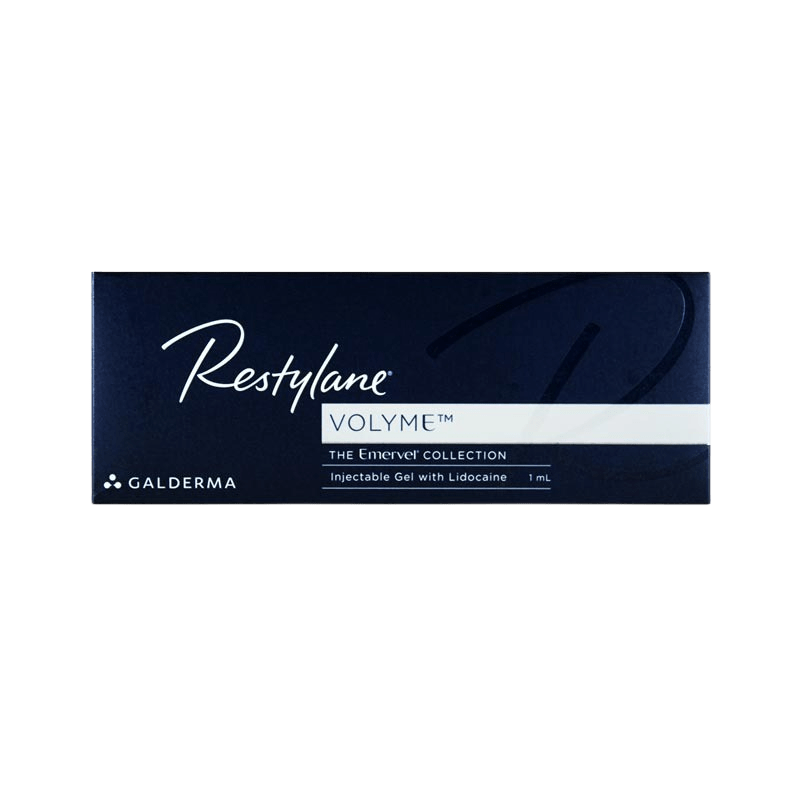
Restylane® Volyme w/ Lidocaine
Order Restylane® Volyme w/ Lidocaine for Clinics
Hyaluronic Acid-Based Filler
$129.00
You save
Description
Restylane® Volyme w/ Lidocaine is a hyaluronic acid dermal filler for professional in-clinic injection, supplied as a 1 mL prefilled syringe. Each syringe contains 20 mg/mL hyaluronic acid with 3 mg/mL lidocaine, supporting clinic planning for facial volume restoration, contour work, sterile handling, and traceable treatment-room documentation. Licensed clinics, med spas, and healthcare professionals can order Restylane Volyme with Lidocaine for practice use through professional supply channels.
Clinic Ordering, Price, and Stock Planning
Restylane Volyme wholesale ordering should start with the clinical role the filler will serve in your injectable formulary. This product is generally selected as a volumizing HA filler when the treatment objective involves restoring facial support or improving contour in areas such as the cheeks, chin, or jawline, when consistent with local labeling and injector judgment.
Current Restylane Volyme with Lidocaine price details are best assessed against the exact commercial unit, expiry visibility, and expected appointment volume. A single 1 mL syringe format can be practical for clinics that need clear lot capture, predictable treatment-room setup, and single-use inventory control. Avoid purchasing solely by brand familiarity if another filler already covers the same structural role in your practice.
Professional account review may include business identification, clinic documentation, and confirmation that the product is being acquired for in-clinic use by trained healthcare professionals. We source brand-name medical products through vetted distributors and verified supply channels for licensed clinics. Teams standardizing a broader Restylane formulary can browse the Restylane brand category for adjacent products and pack-level context.
Quick tip: Match order quantity to real procedure demand, injector training, and expiry rotation rather than stocking every filler in the same volume.
Product Role and Treatment-Room Fit
Restylane® Volyme w/ Lidocaine is positioned within the Restylane portfolio as a facial volume filler rather than a superficial line-softening product. The hyaluronic acid gel is used by qualified injectors when projection, contour support, and volume restoration are the main planning goals. Lidocaine is included to improve injection comfort during professional administration.
Clinics commonly separate volumizing fillers from products used for fine lines, lip definition, or skin-quality hydration. That distinction matters during procurement because two HA fillers can share the same active material class while performing differently in tissue. A product chosen for deeper support should not automatically replace a softer gel intended for more superficial refinement.
For teams refining treatment protocols, the broader Restylane dermal filler treatments resource can help frame class-level planning. Clinics evaluating comfort features across injectables can also review lidocaine in dermal filler procedures as a practical background reference.
- Product class: hyaluronic acid dermal filler
- Use setting: professional in-clinic injection
- Main planning goal: facial volume and contour support
- Comfort feature: lidocaine included in the formulation
- Format: sterile prefilled syringe for single use
Forms, Strengths, and Packaging
Restylane® Volyme w/ Lidocaine is commonly presented as a sterile injectable gel in one 1 mL prefilled syringe. The formulation contains 20 mg/mL hyaluronic acid and 3 mg/mL lidocaine, also described as 0.3% lidocaine. Clinics should match the carton, syringe label, invoice, and instructions for use during receipt checks.
Market-specific carton design, included accessories, and local labeling can vary. Intake staff should verify seal integrity, product name, lot number, and expiry before placing the unit into injectable inventory. The syringe is single use, so opened or partly used material should not be retained for a later appointment.
| Attribute | Details |
|---|---|
| Form | Sterile injectable gel in a prefilled syringe |
| Hyaluronic acid concentration | 20 mg/mL |
| Lidocaine concentration | 3 mg/mL, or 0.3% |
| Presentation | 1 x 1 mL prefilled syringe |
| Use pattern | Single-use professional administration |
Why it matters: Syringe size, lidocaine content, and lot capture affect ordering accuracy, chart documentation, and treatment-room setup.
Professional Administration and Documentation
Administration should be performed only by clinicians trained in facial anatomy, aseptic technique, dermal filler behavior, and complication management. Injection depth, tissue plane, instrument choice, and total product use depend on the approved local labeling, patient anatomy, treatment objective, and the injector’s professional assessment. This content does not provide dosing or injection technique instructions.
Before use, clinics should complete a structured assessment that includes treatment indication, allergy history, prior filler history, relevant facial procedures, photography, consent, and contraindication screening. Baseline notes on asymmetry, animation, skin integrity, and previous treatment patterns help the injector interpret post-treatment findings more safely.
Multi-injector clinics benefit from written workflows for facial mapping, site notation, product amount used, lot label placement, and follow-up instructions. Staff should also know how to escalate urgent symptoms if a concern arises by phone after the patient has left the clinic. Protocol consistency reduces variation when several providers administer the same filler line.
- Before treatment: document indication, assessment, and consent
- During treatment: maintain aseptic setup and clear visualization
- After treatment: assess comfort, symmetry, perfusion, and tolerability
- Charting: record product name, lot number, treated area, and amount used
Storage, Handling, and Clinic Logistics
Unopened syringes should remain in their original packaging until use and be stored according to the manufacturer’s labeled conditions. Avoid excessive heat, freezing conditions, direct light, and damaged cartons. These controls help preserve sterility assurance, product identification, and traceability during internal reviews or audits.
Stock should be rotated by expiry and separated from other injectable inventory to reduce selection errors. A clinic that carries several Restylane fillers should keep clear shelf organization, especially when syringes share similar concentrations but have different treatment roles. Temperature-controlled handling when required and tracked US delivery may be used as part of clinic supply logistics.
At receipt, quarantine any unit with broken seals, unclear labeling, unexplained particulates, carton damage, or a mismatch between invoice and packaging. Reception and clinical staff should use the same intake checklist so discrepancies are caught before a syringe reaches the treatment room.
- Inspect seal integrity at receipt
- Record lot and expiry promptly
- Keep outer packaging with inventory records
- Rotate stock by expiry date
- Separate compromised units for review
Safety, Contraindications, and Monitoring
Contraindications and exclusions should be verified against the market-specific instructions for use supplied with the product. Clinics typically avoid HA filler treatment in patients with known hypersensitivity to hyaluronic acid fillers, lidocaine, or formulation components, and at sites with active infection, significant inflammation, or compromised skin integrity.
Careful assessment is also important in patients with previous filler complications, bleeding tendency, immune or inflammatory skin conditions, recent dental work, recent laser or peel procedures, trauma near the intended site, or unknown prior filler material. Because Restylane Volyme with Lidocaine contains a local anesthetic, clinicians should account for relevant anesthetic sensitivity and other lidocaine exposure during the same visit.
Expected short-term reactions after dermal filler injection can include swelling, redness, bruising, tenderness, firmness, itching, and temporary asymmetry. More serious events can include infection, hypersensitivity, delayed inflammatory nodules, persistent edema, granulomatous changes, and vascular compromise. Red-flag symptoms such as severe pain, blanching, dusky discoloration, livedo change, visual symptoms, neurologic symptoms, fever, or rapidly worsening swelling require urgent clinical assessment and escalation.
Practices using structural HA fillers should maintain a written vascular-occlusion protocol, hyaluronidase access consistent with clinic policy, and referral pathways that staff can activate without delay. A complication plan should be in place before the first syringe is opened, not created during an emergency.
- Screen for allergy history, active infection, and skin integrity concerns
- Review prior filler type and previous adverse events
- Consider bruising risk with anticoagulants, antiplatelets, or relevant supplements
- Monitor for ischemic, visual, neurologic, or infectious red flags
- Document onset, severity, progression, and actions taken
How It Compares With Other Restylane Fillers
Comparison should begin with treatment objective. Restylane Volyme filler is generally planned for volume restoration and contour support. Other Restylane products may fit different roles, including projection, dynamic expression areas, lip-focused work, or softer correction. Procurement teams should define one primary role for each filler to reduce overlap and training confusion.
Restylane Lyft w/ Lidocaine may be considered when a clinic is evaluating another Restylane HA filler with a structural planning profile. Restylane Refyne w/ Lidocaine and Restylane Defyne w/ Lidocaine belong in related Restylane comparisons, but a clinic should not substitute one product for another without reassessing tissue plane, correction style, consent language, and injector familiarity.
Lip-focused or skin-quality treatments require a different product decision. Restylane Kysse w/ Lidocaine is commonly discussed in lip-focused Restylane planning, while hydration-oriented protocols may be better reviewed through Restylane Skinboosters clinical planning. For brand-to-brand formulary decisions, Restylane and Juvederm comparison content can support broader procurement discussions.
- Volumizing role: facial support and contour planning
- Softer correction role: line blending or flexible movement areas
- Lip role: product selection centered on lip anatomy and goals
- Skin-quality role: hydration and texture-focused injectable planning
Duration, Patient Selection Questions, and Practice Expectations
Clinics often ask how long Restylane Volyme lasts because duration affects consultation language, follow-up intervals, and repeat-order planning. Longevity varies by treatment area, product amount, tissue dynamics, metabolism, technique, and individual patient factors. Avoid presenting a fixed outcome guarantee in consent or marketing materials unless it aligns with the applicable product labeling and clinic policy.
Patient age alone does not determine whether a dermal filler is suitable. Older adults may have volume loss, skin laxity, medication considerations, or vascular risk factors that require a more careful assessment. Younger patients may also be poor candidates if the indication is unclear or if expectations are unrealistic. Procurement should support clinical judgment rather than create pressure to use stock before expiry.
Search interest also asks about the thinnest Restylane filler and the difference between Restylane Lyft and Restylane Volyme. Those questions should be answered within a professional product-selection framework. Rheology, intended tissue plane, treatment area, and labeling matter more than ranking fillers as simply thin or thick. A structured formulary note can help injectors select the right syringe for the intended correction.
Availability, Substitution, and Inventory Control
Restylane® Volyme w/ Lidocaine can be ordered for professional clinic use, with purchasing decisions based on the unit description, clinic documentation, and supply channel requirements. Before placing stock into rotation, verify the exact 1 mL syringe presentation, concentration, lot number, expiry, and carton condition.
Substitution should be handled conservatively. Differences in gel structure, lift, spread, and intended treatment depth mean that another HA filler should not be treated as an automatic replacement. If a clinic changes product line because of formulary decisions or temporary stock planning, the injector should review the clinical goal, consent wording, and documentation template.
Inventory teams can reduce waste by assigning Restylane Volyme with Lidocaine to a specific role in the clinic. If the practice already carries another volumizing filler, compare expected use, staff familiarity, training needs, and follow-up burden before duplicating the category.
Authoritative Sources
Use the product carton and instructions for use as the primary reference for indications, contraindications, administration limits, storage, and adverse-event procedures. The sources below provide product-family context and regulator-backed dermal filler safety information.
- For brand and portfolio context, see Restylane brand information.
- For regulator-backed safety information, review FDA dermal fillers and soft tissue fillers.
This content is for informational purposes only and is not a substitute for professional medical advice.
Frequently Asked Questions
Who can order Restylane® Volyme w/ Lidocaine?
Restylane® Volyme w/ Lidocaine is intended for professional in-clinic use. Ordering is appropriate for licensed clinics, med spas, aesthetic practices, and healthcare professionals that can meet business documentation, training, storage, and treatment-room governance requirements.
What is in one syringe of Restylane Volyme with Lidocaine?
The commonly supplied presentation is one 1 mL prefilled syringe containing 20 mg/mL hyaluronic acid and 3 mg/mL lidocaine, also described as 0.3% lidocaine. Clinics should verify the carton, syringe label, invoice, lot, expiry, and instructions for use at receipt.
Is Restylane Volyme mainly for cheeks, chin, and jawline?
Restylane Volyme is generally positioned as a facial volume and contour filler, often considered for areas such as the cheeks, chin, or jawline when consistent with local labeling and injector assessment. Final treatment planning depends on anatomy, indication, technique, and professional judgment.
How should clinics store Restylane Volyme w/ Lidocaine?
Keep unopened syringes in the original packaging and follow the manufacturer’s labeled storage conditions. Avoid excessive heat, freezing, direct light, damaged packaging, and unclear labeling. Record lot and expiry promptly, rotate stock by expiry, and quarantine compromised units.
Can another Restylane filler replace Restylane Volyme?
Not automatically. Restylane fillers may differ in gel behavior, lift, spread, intended tissue plane, and treatment role. If a clinic substitutes another product, the injector should reassess the clinical goal, consent wording, documentation, and familiarity with the alternative filler.
What safety protocols should be in place before use?
Clinics should have trained injectors, aseptic setup, contraindication screening, allergy and prior-filler review, lot tracking, aftercare instructions, adverse-event documentation, and an urgent escalation pathway. Structural filler use should also be supported by a written vascular-occlusion protocol and appropriate emergency resources.
Specifications
- Main Ingredient: Cross-Linked Hyaluronic Acid 20Mg/Ml Lidocaine Hydrochloride 3Mg/Ml Physiological Buffer Ph 7 Qs Ad 1 Ml
- Manufacturer: Galderma
- Drug Class: Aesthetic Surgery Product
- Generic Name: Cross-Linked Hyaluronic Acid
- Package Contents: 1 mL x 1 Pre-Filled Syringe
- Storage Requirements: Room Temperature (2℃~25℃)
- Main Usage: Volume Filler
About the Brand
Restylane
Restylane stands as a trusted medical brand, providing an extensive variety of injectable dermal fillers designed to rejuvenate facial appearance and minimize aging signs. These products, infused with hyaluronic acid, are renowned for results that embody natural aesthetics and exhibit prolonged effectiveness. On medwholesalesupplies.com, we present Restylane offerings at market competitive rates, facilitating medical experts in keeping these premium dermal fillers on hand. By choosing to acquire Restylane via medwholesalesupplies.com, medical practitioners stand to gain numerous advantages. To begin with, our online platform simplifies the ordering process and lessens the exertion involved in sourcing these medical essentials. Furthermore, by offering Restylane at wholesale prices, we provide an opportunity for practitioners to achieve monetary savings when making bulk purchases. Finally, we place a high emphasis on customer contentment and guarantee only authentic products on our website. Therefore, when purchasing Restylane from medwholesalesupplies.com, you can rest assured you are obtaining genuine articles. In summary, Restylane represents a reliable medical brand furnishing prime quality dermal fillers to aid in facial revival. Through medwholesalesupplies.com, medical specialists can swiftly secure Restylane products at wholesale prices, saving both time and resources while ensuring product genuineness. Unlock the potential of Restylane, a trusted name in cosmetic fillers, through Med Wholesale Supplies. Whether you're looking to enhance lips with Restylane for lips or seeking the best Restylane filler for various treatments, we have you covered. Explore Restylane prices to find affordable solutions that meet your needs. Our expert-curated selection ensures you can deliver the best results to your clients with confidence. Choose Med Wholesale Supplies for all your Restylane products and more!
Browse Restylane Products
Here to help
Questions about ordering, delivery or products? You can email our team here or call now at 1-800-630-9757 and be connected with your dedicated Account Manager
Related Products
Evenity® (English Alternative)
Injectable Medication
$1,229.00 - $1,299.00
You save
You save
Intraline® For Men
Dermal Filler
$59.00 - $79.00
You save
You save
RejuvaNAD+ Pro
Injectable Medication
$237.00 - $249.00
You save
You save
Teosyal® RHA 4
Aesthetic Surgery Product
$259.00 - $279.00
You save
You save
Related Articles
Prednisone in Clinical Care: Uses, Risks, and Monitoring
Prednisone is a prescription systemic corticosteroid used to reduce inflammation or suppress immune activity in…
Lip Fillers Swelling Stages: Timeline, Safety, and Follow-Up
Lip fillers swelling stages usually follow a short inflammatory course: swelling appears soon after injection,…
Hypopigmentation of the Skin: Assessment and Care
Hypopigmentation of the skin means one or more areas look lighter than the surrounding skin.…
Radiesse vs Sculptra: Selection Factors for Clinics
Radiesse vs Sculptra is best understood as a comparison between two collagen-stimulating injectables with different…
Hyaluronic Acid Under-Eye Filler: Safety and Workflow
Hyaluronic acid under-eye filler is an injectable soft-tissue filler used by trained aesthetic clinicians to…
Dermal Filler Types: Materials, Uses, and Clinic Fit
Dermal filler types are usually grouped by their base material, tissue behavior, and expected role…
What Is Dysport? Clinical Uses, Safety, and Workflow
For clinic teams asking what is Dysport, the short answer is simple: Dysport is a…
Biostimulators in Aesthetic Care: Selection and Safety
Biostimulators are injectable aesthetic products used to encourage a controlled tissue response, often involving new…