
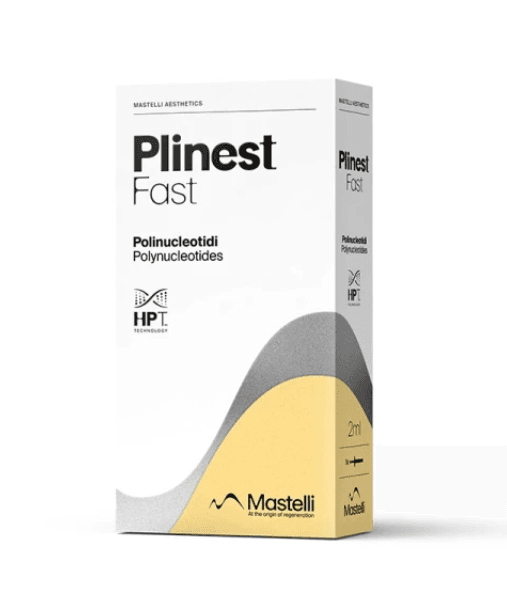
Description
Plinest® Fast is a Mastelli polynucleotide injectable used by aesthetic clinics as a skin booster for dermal revitalization and skin-quality support. Licensed clinics and healthcare professionals can order Plinest Fast for professional treatment-room use with attention to sterile handling, traceable receiving, and batch-level documentation. Clinic teams should match the product received to the carton and manufacturer instructions for use before adding it to any protocol.
Polynucleotides are DNA fragment-based biopolymers commonly used in aesthetic medicine to support hydration, texture, elasticity, and overall skin quality rather than create structural volume. Plinest Fast is therefore best evaluated as a regenerative skin-quality injectable, not as a classic volumizing filler. Protocol choice, injection technique, treatment interval, and patient selection remain clinical decisions for trained healthcare professionals working from the supplied IFU and local scope-of-practice requirements.
Plinest Fast Ordering, Price, and Clinic Account Requirements
Clinics can purchase Plinest® Fast through a professional account and view the current Plinest Fast price during ordering. Because catalog pricing and allocation can change, purchasing teams should use the live cart price, current quantity, and product name shown at checkout for purchase orders. The order should also align with internal policies for receiving, lot capture, expiration tracking, and treatment-record reconciliation.
Professional-use ordering is intended for licensed facilities, medical spas, aesthetic practices, and healthcare professionals. Account review may require clinic credentials, facility information, business shipping details, and confirmation that authorized staff are placing orders. These controls support controlled distribution and help clinic teams maintain a clean chain of custody from procurement to use.
When your clinic evaluates quantity, consider scheduled treatment volume, staff training status, and the shelf-life window shown on the unit received. Avoid ordering beyond realistic utilization if your protocol is still being introduced or if provider competency sign-offs are pending. For adjacent category planning, clinic teams can browse professional skin-quality inventory in the skin boosters category and related aesthetic injectables in the mesotherapy category.
Professional-Use Context and Indications
Plinest® Fast is positioned by Mastelli within aesthetic medicine and dermocosmetic applications as a polynucleotide product for dermal revitalization. In everyday clinic language, it is often discussed as a Plinest Fast skin booster because treatment goals typically focus on improved skin appearance, hydration support, texture, and dermal repair. Exact indications, anatomical areas, and treatment parameters should be taken from the IFU supplied with the batch your clinic receives.
The practical benefit of Plinest Fast is its fit within skin-quality programs where the endpoint is refreshed, healthier-looking skin rather than lift or contour. It may be considered for protocols that address fine texture concerns, dullness, dehydration appearance, or tissue-quality support, depending on clinician assessment and labeling. Patient-facing claims should stay conservative and should not promise uniform timing, a guaranteed before-and-after outcome, or a specific duration of effect.
For clinic education, the internal Plinest injection clinical discussion can help staff develop consistent counseling language around polynucleotide treatments. Broader category education is also available through skin booster practice updates, which can support staff training without replacing manufacturer instructions or hands-on technique education.
Presentation, Package Checks, and Receiving Workflow
Plinest Fast is commonly referenced in the market as a prefilled syringe presentation, and many commercial references discuss a 2 mL format. Packaging, language, accessories, and regional labeling can vary by distributor route, so the receiving team should rely on the product carton, label, and IFU rather than third-party photos. Confirm the name, presentation, lot number, expiration date, and package integrity before releasing inventory for clinical use.
Receiving should happen before the product enters treatment-room stock. Record lot and expiration data at intake, photograph damaged cartons if your SOP requires it, and quarantine any product with broken seals or unclear labeling until a responsible clinical or procurement lead reviews it. Single-use injectable items should remain sealed until preparation for the individual procedure.
| Receiving step | What staff should verify | Clinic reason |
|---|---|---|
| Identity match | Product name, manufacturer, carton, and IFU language | Reduces protocol mismatch and documentation errors |
| Traceability | Lot number and expiration date captured at intake | Supports audit-ready treatment records and recall response |
| Package condition | Seals intact, carton undamaged, solution appearance consistent with IFU | Helps protect sterility and product integrity |
| Inventory routing | Storage location and category assignment recorded | Keeps injectable stock organized for authorized users |
Quick tip: Capture lot and expiry during receiving, not after the patient has been roomed.
Administration Fit, Training, and Documentation
Plinest Fast injection procedures should be performed only by appropriately trained healthcare professionals using aseptic technique and the manufacturer’s instructions. Polynucleotide skin boosters are commonly used with superficial or intradermal aesthetic techniques, but the exact injection plane, volume per point, spacing, and session plan must come from clinical training and the IFU. Clinics should keep patient selection, consent, and complication readiness within the supervising clinician’s protocol.
Documentation should be detailed enough for continuity of care. Typical records include consent, medical history review, treatment area, product name, lot, expiration date, injection approach, immediate tolerance, and aftercare instructions. If your EMR supports inventory fields, make lot and expiration mandatory so the treatment record remains complete even during busy treatment sessions.
Staff training should cover anatomy, asepsis, product preparation, expected post-procedure findings, adverse-event escalation, and patient communication. Clinics that combine skin boosters with microneedling, energy-based devices, peels, or mesotherapy programs should define sequencing rules in writing. The practice article on PRP therapy for skin regeneration may help teams frame regenerative-service workflows across different modalities.
Why it matters: Standard documentation makes follow-up, inventory reconciliation, and complication review easier.
Storage, Handling, and US Logistics
Storage conditions must follow the IFU and outer carton label supplied with the product. A conservative clinic workflow keeps Plinest® Fast in its original packaging until use, protects it from unnecessary light exposure when labeling calls for it, and prevents avoidable temperature excursions. Injectable products should be separated by category, access-controlled for trained staff, and handled with clean preparation practices.
Day-to-day handling should preserve sterility and traceability. Keep syringes sealed until procedure preparation, avoid placing injectable stock on contaminated surfaces, and discard single-use items immediately after use according to facility policy. If a shipment arrives with visible damage, temperature concerns, or labeling discrepancies, quarantine it and complete your internal review before clinical release.
Our logistics process supports temperature-controlled handling when required and tracked US delivery. Clinic teams should still inspect products at arrival and document any receiving concern promptly. Inventory is best rotated by expiration date, with near-expiry stock flagged before scheduling so providers do not discover a timing issue during treatment-room setup.
Safety, Contraindications, and Monitoring
Plinest Fast should be used only when patient assessment supports an injectable skin booster procedure and the IFU does not list a relevant contraindication. As with other injectable aesthetic treatments, clinicians commonly defer treatment when active infection, inflammation, or open skin is present at the intended site. A history of hypersensitivity, significant scarring tendency, impaired wound healing, autoimmune disease considerations, pregnancy or breastfeeding status, and immunosuppression should be evaluated according to the product labeling and clinic policy.
Expected local reactions after intradermal injectables can include redness, swelling, tenderness, itching, pinpoint bleeding, and bruising. Small palpable bumps or temporary unevenness may occur depending on injection depth, technique, and tissue response. Staff should explain expected recovery using clinic-approved aftercare language and should avoid promising an exact Plinest Fast results timeline because response can vary by protocol, patient factors, and treatment area.
Serious complications are uncommon but require readiness. Clinics should monitor for disproportionate pain, skin color change, rapidly progressive swelling, visual symptoms, signs of infection, or symptoms suggesting hypersensitivity. Any concern for vascular compromise or severe reaction should follow the clinic’s escalation pathway without delay. The FDA’s safety information on dermal filler risks and safety provides useful background for injectable aesthetic risk discussions, even when product categories differ.
Medication and procedure-related cautions should be reviewed before treatment. Anticoagulants and antiplatelet agents can increase bruising risk, while active dermatologic disease, recent aggressive resurfacing, or irritated skin may influence scheduling. Sequencing with chemical peels, lasers, microneedling, retinoids, and other injectables should be defined by the treating clinician to minimize cumulative irritation and protect barrier recovery.
How Plinest Fast Compares With Related Skin Boosters
Clinics often compare Plinest Fast with other polynucleotide and skin booster options by intended treatment area, tissue-quality goals, patient tolerance, protocol design, and labeling. Plinest Fast is generally discussed for skin revitalization and rapid integration into skin-quality programs, while other products in the family may be positioned differently. The difference between Plinest and Plinest Fast should be confirmed from the specific IFUs and training materials rather than from informal comparison charts.
Plinest may be considered when clinics want to evaluate the broader brand family, while Plinest One is another related product often reviewed during protocol planning. Clinics that treat delicate periocular concerns may also look at Plinest Eye, using the supplied labeling to decide whether it fits the intended area and technique. Product choice should be made by the supervising clinician, with staff trained on the exact item being used.
Polynucleotide products are also compared with HA-based skin boosters, amino-acid solutions, vitamin-based mesotherapy products, and autologous treatments. HA skin boosters typically emphasize hydration and viscoelastic support, while PN products emphasize tissue-quality and repair-support language. If your clinic is building a broader regenerative menu, the article on Croma Philart and polynucleotide concepts offers additional context for comparing treatment categories.
Result Expectations and Patient Communication
Search interest around Plinest Fast often focuses on benefits, before-and-after outcomes, and how long results take to appear. In clinic communication, the safest answer is that visible changes depend on patient factors, treatment area, session plan, baseline skin condition, and combination therapies. Staff should describe the intended skin-quality goals, expected temporary injection-site reactions, and follow-up schedule defined by the clinician.
Before-and-after materials should reflect real clinic outcomes, appropriate consent, consistent lighting, and accurate timing. Avoid using manufacturer or social media claims as a substitute for patient-specific counseling. If a patient asks whether Plinest Fast is a filler, clarify that it is commonly grouped with skin boosters and polynucleotide injectables rather than structural volumizing fillers.
Aftercare instructions should be practical and consistent across providers. Common clinic policies address makeup timing, exercise, heat exposure, skin care actives, signs that require contact, and when the next session may be considered. A standardized handout reduces inconsistent verbal guidance and helps patients understand which symptoms are expected versus which require prompt review.
Availability, Substitutions, and Inventory Planning
Plinest® Fast is available for professional ordering through the store, with final quantity and current cost shown during checkout. If clinic demand changes, purchasing staff should coordinate with providers before increasing standing quantities. New protocols often benefit from smaller initial inventory, staff competency review, and clear scheduling plans before routine reorder levels are set.
If a similar product is considered as a substitution, the supervising clinician should evaluate the IFU, product category, intended injection plane, storage needs, contraindications, and patient communication requirements. A similar-sounding skin booster is not automatically interchangeable in a clinic protocol. Update templates, consent language, and inventory fields when the product name or IFU changes.
Receiving and treatment logs should support rapid product tracing. Maintain records that connect purchase order, lot, expiration, provider, treatment date, and patient chart. This level of documentation is valuable for routine audits, quality review, and any future manufacturer or regulator communication.
Authoritative Sources
Clinic protocols should prioritize primary materials: the manufacturer’s IFU, carton label, training documentation, and applicable regulator safety communications. Internal education and category articles can support workflow, but they should not replace hands-on training or the instructions supplied with the product.
- Manufacturer product-line context: Mastelli official website
- Injectable aesthetic safety background: FDA dermal filler safety information
This content is for informational purposes only and is not a substitute for professional medical advice.
Frequently Asked Questions
What is Plinest Fast used for in aesthetic clinics?
Plinest Fast is a Mastelli polynucleotide injectable used in professional aesthetic practice as a skin booster for dermal revitalization and skin-quality support. Clinics should follow the IFU supplied with the product for indications, technique, and use limitations.
Can clinics order Plinest Fast online?
Licensed clinics, medical spas, and healthcare professionals can order Plinest Fast through a professional account. Account review may require facility and credential information, and the current price and quantity are shown during ordering.
Is Plinest Fast the same as a dermal filler?
Plinest Fast is commonly grouped with skin boosters and polynucleotide injectables rather than classic volumizing fillers. It is typically evaluated for skin-quality goals such as texture, hydration appearance, and dermal revitalization, while structural fillers are used for contour or volume.
What should staff check when receiving Plinest Fast?
Receiving staff should confirm the product name, manufacturer, package integrity, lot number, expiration date, IFU, and storage instructions. Any damaged, unclear, or out-of-spec shipment should be quarantined until reviewed under clinic policy.
What side effects should clinics discuss before treatment?
Common post-injection effects can include redness, swelling, tenderness, itching, pinpoint bleeding, bruising, or small temporary bumps. Clinics should also counsel patients on urgent warning signs such as severe pain, skin color change, visual symptoms, rapidly worsening swelling, infection signs, or hypersensitivity symptoms.
What is the difference between Plinest and Plinest Fast?
Both belong to the Plinest brand family, but positioning, protocol fit, and labeled instructions may differ. Clinics should compare the exact IFU, intended treatment area, injection technique, contraindications, and documentation needs before choosing between Plinest and Plinest Fast.
Specifications
- Main Ingredient: Polynucleotides
- Manufacturer: Mastelli Aesthetics
- Drug Class: Cosmetic Injectable
- Generic Name: Polynucleotides
- Package Contents: 1x2ml pre-filled syringe
- Storage Requirements: Room Temperature (5℃~25℃)
- Main Usage: Anti Ageing
Here to help
Questions about ordering, delivery or products? You can email our team here or call now at 1-800-630-9757 and be connected with your dedicated Account Manager
Related Products
Evenity® (English Alternative)
Injectable Medication
$1,229.00 - $1,299.00
You save
You save
Intraline® For Men
Dermal Filler
$59.00 - $79.00
You save
You save
RejuvaNAD+ Pro
Injectable Medication
$237.00 - $249.00
You save
You save
Teosyal® RHA 4
Aesthetic Surgery Product
$259.00 - $279.00
You save
You save
Related Articles
Prednisone in Clinical Care: Uses, Risks, and Monitoring
Prednisone is a prescription systemic corticosteroid used to reduce inflammation or suppress immune activity in…
Lip Fillers Swelling Stages: Timeline, Safety, and Follow-Up
Lip fillers swelling stages usually follow a short inflammatory course: swelling appears soon after injection,…
Hypopigmentation of the Skin: Assessment and Care
Hypopigmentation of the skin means one or more areas look lighter than the surrounding skin.…
Radiesse vs Sculptra: Selection Factors for Clinics
Radiesse vs Sculptra is best understood as a comparison between two collagen-stimulating injectables with different…
Hyaluronic Acid Under-Eye Filler: Safety and Workflow
Hyaluronic acid under-eye filler is an injectable soft-tissue filler used by trained aesthetic clinicians to…
Dermal Filler Types: Materials, Uses, and Clinic Fit
Dermal filler types are usually grouped by their base material, tissue behavior, and expected role…
What Is Dysport? Clinical Uses, Safety, and Workflow
For clinic teams asking what is Dysport, the short answer is simple: Dysport is a…
Biostimulators in Aesthetic Care: Selection and Safety
Biostimulators are injectable aesthetic products used to encourage a controlled tissue response, often involving new…