
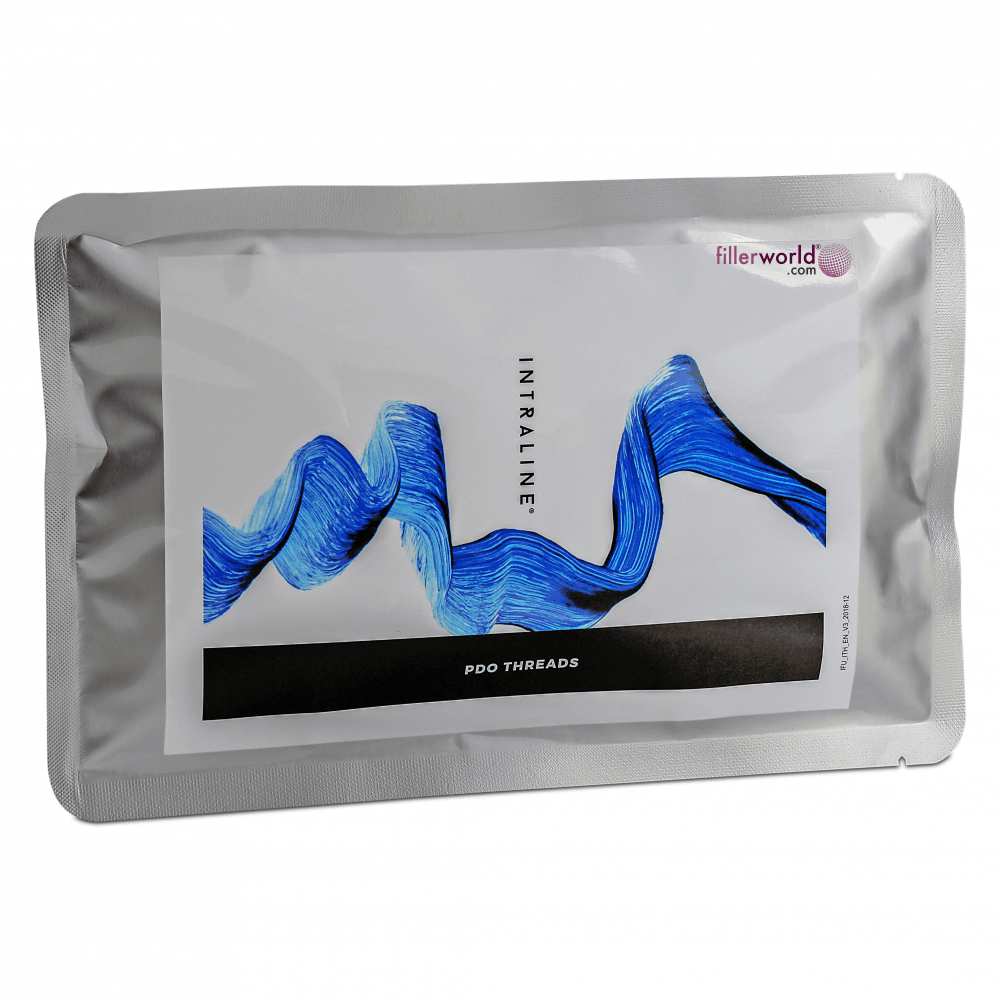
Intraline®Mono 29G 38 50 6-0
Order Intraline® Mono 29G 38/50 6-0 for Clinics
Medical Device
$100.00
You save
Description
Intraline® Mono 29G 38 50 6-0 are sterile polydioxanone mono threads for professional aesthetic use in licensed clinical settings. Clinics use this 29G, 6-0 PDO mono thread configuration for minimally invasive soft-tissue support, contour refinement, and protocol-based treatment-room workflows. Licensed clinics and healthcare professionals can order Intraline Mono 29G wholesale with US distribution and practical documentation for inventory control.
The product is designed for trained personnel who need a fine-gauge delivery needle, smooth monofilament behavior, and predictable handling across delicate facial areas. The 38 mm and 50 mm working lengths help practices match short linear passes, fanning patterns, or localized mesh placement to the treatment plan and patient anatomy.
Intraline Mono 29G Price and Clinic Ordering
Current Intraline Mono 29G price details are available after account sign-in. Wholesale access is intended for licensed clinics, med spas, and healthcare professionals purchasing professional-use medical devices for practice inventory. Account approval may include review of clinic credentials, business information, and documentation needed to support B2B medical-supply ordering.
When placing a bulk order, select the thread configuration that matches your clinic protocol, including the 29G delivery needle, 38 mm or 50 mm working length, and 6-0 PDO mono format. Practices that perform threading frequently may standardize both lengths so staff can stock treatment rooms with a consistent gauge while choosing the most practical length for the planned vector.
For wider supply planning, clinics can browse adjacent professional products in medical devices or review the Intraline brand range. This keeps purchasing aligned when a site uses multiple thread types or wants to consolidate related aesthetic supplies under one internal procurement process.
What the 29G 38/50 6-0 Configuration Means
Intraline PDO Mono Threads 29G use a smooth polydioxanone monofilament loaded on a fine delivery needle. The 29G needle supports a clean entry profile for delicate zones, while the 6-0 thread calibre gives the device a light, flexible handling character suited to subtle tissue support rather than aggressive repositioning.
The 38 mm length is commonly useful for compact vectors, short linear runs, and smaller treatment zones that require controlled placement. The 50 mm length can help when a longer pass supports the clinician’s planned fanning or linear pattern. Both lengths allow practices to maintain a familiar needle gauge while adapting placement to zone size and tissue characteristics.
PDO is a resorbable polymer used in absorbable surgical materials. In aesthetic threading, a mono thread provides immediate mechanical presence in the placed plane, then gradually hydrolyzes over time. As the material resorbs, local tissue response may support collagen remodeling, although clinical outcomes depend on patient selection, placement technique, anatomy, and the overall treatment plan.
Professional Applications and Treatment-Room Fit
Clinics incorporate Intraline Mono Threads 29G 38/50 into non-surgical facial contouring workflows where light support and skin-quality improvement are the goal. Typical professional-use zones may include perioral areas, jawline transitions, malar and midface contours, crow’s feet, and the glabella-lateral brow complex when appropriate for the patient and within the clinician’s scope of practice.
The smooth mono design supports linear threading, fanning, or small mesh patterns according to clinic protocol. It is often selected when the provider wants a lighter thread format with predictable passage through the planned subdermal plane. Practices may use mono threads as a standalone procedure or schedule them around injectables or energy-based treatments according to internal clinical policy.
For foundational discussion of PDO thread mechanisms, clinic teams can review PDO thread mechanisms and use. For risk-focused staff education, thread-lift risks and challenges can support procedure planning conversations and reinforce the need for qualified placement.
Key Features for Aesthetic Practices
- Sterile PDO monofilament thread for professional aesthetic threading procedures.
- 29G delivery needle for fine, controlled placement in delicate facial zones.
- 38 mm and 50 mm working lengths for different vector lengths and treatment areas.
- 6-0 mono calibre for light support, flexibility, and consistent tactile feedback.
- Smooth thread profile suited to linear placement, fanning, and small mesh patterns.
- Single-use format to support controlled procedure-room handling.
- Labeling includes lot and expiration information for clinic traceability records.
- Compatible with protocol-based aesthetic workflows managed by licensed staff.
Quick tip: Stocking both 38 mm and 50 mm lengths can simplify room setup while preserving flexibility during treatment planning.
Composition, Mechanism, and Expected Role
The thread material is polydioxanone, commonly abbreviated PDO. It is a resorbable synthetic polymer that breaks down by hydrolysis. In a mono thread format, the device does not rely on barbs or cones for anchoring; instead, it provides a smooth filament designed for subtle support and tissue-response stimulation around the placed thread path.
Because this is a device-only product, it does not contain an active pharmaceutical ingredient. Its role is mechanical and structural, with the resorbable material gradually losing presence over time. Clinics should avoid presenting mono threads as equivalent to stronger cog or barbed configurations, because those designs serve different vectoring and tissue-engagement goals.
Patient-facing claims should remain conservative and consistent with clinic training. Expected results vary with skin quality, age-related tissue changes, treatment pattern, and aftercare adherence. Providers should assess contraindications, discuss realistic expectations, and document the planned use before treatment.
Packaging, Storage, and Handling
Intraline Mono 29G 38 50 6-0 is supplied as a sterile, single-use thread device for professional environments. The device should remain in its original sterile packaging until the procedure setup is ready. Staff should inspect packaging integrity, confirm the lot number and expiration date, and document the item according to clinic policy before use.
Do not reuse or resterilize a single-use thread device. Any opened, damaged, expired, or compromised unit should be handled according to the clinic’s medical-device waste procedures. Treatment rooms should maintain aseptic workflow, appropriate sharps handling, and staff competency for percutaneous placement.
For logistics, orders may be managed with temperature-controlled handling when required and tracked US delivery. Clinics should reconcile received quantities against purchase records and rotate inventory so earlier expiration dates are used first. This helps reduce waste while supporting consistent procedure scheduling.
Safety, Contraindications, and Documentation
PDO thread placement is a professional procedure and should be performed only by trained clinicians working within applicable medical and aesthetic practice standards. Common post-procedure effects may include local tenderness, swelling, bruising, redness, and transient irregularity near insertion paths. More serious risks can include infection, asymmetry, thread visibility, extrusion, dimpling, vascular or nerve-related complications, and unsatisfactory aesthetic outcome.
Clinicians should screen for factors that may affect suitability, such as active infection at the treatment site, poor wound healing, relevant bleeding risk, anticoagulant use, autoimmune or inflammatory skin conditions, allergy or sensitivity concerns, and recent procedures in the same area. Product choice should also account for skin thickness, tissue laxity, treatment-zone anatomy, and whether the patient’s goals require a different thread design.
Documentation should identify the device used, treatment zones, placement pattern, lot number, expiration date, clinician, and any immediate observations. Aftercare instructions should be consistent with clinic protocol and should tell patients when to contact the practice for worsening pain, spreading redness, fever, discharge, increasing asymmetry, or other concerning symptoms.
Inventory Planning for Bulk Thread Purchasing
Clinics that buy Intraline Mono Threads in bulk should plan inventory around procedure volume, practitioner preferences, and the areas most often treated. A clinic focused on periorbital finesse may use more 38 mm threads, while a practice treating longer facial vectors may draw more heavily from the 50 mm length. Standardizing the gauge can reduce training friction and keep tactile feedback consistent across rooms.
Internal requisitions should name the complete device description, such as Intraline® Mono 29G 38/50 6-0, to avoid confusion with other Intraline thread families. The broader Intraline range includes mono, spiral, and cog configurations, and those designs should not be treated as interchangeable without clinical review.
For technique education and product-family context, Intraline applications in anti-aging treatments gives a broader brand-focused discussion. Clinics using fillers alongside thread protocols may also find facial contouring with Intraline dermal fillers useful for planning staged aesthetic services.
Related Thread Choices
Mono threads are useful when the goal is light support and skin-quality improvement, but some cases call for a different thread architecture. For adjacent mono-thread selection, clinics can review Intraline Mono 29G 50/70 6-0 when a longer configuration better fits planned vectors. The Intraline PDO Thread M2738 Mono may also be relevant for practices comparing nearby mono-thread formats.
When greater tissue engagement is desired, a spiral design may be considered under clinician direction. Intraline Spiral S2938 29G 38mm/50mm provides a related configuration for clinics evaluating alternatives within the same general procedure category. Selection should remain based on anatomy, treatment objective, practitioner training, and clinic policy.
Authoritative Sources
For background on the material and the broader clinical literature, consult these external references. They are not a substitute for product labeling, professional training, or clinic-specific protocols.
This content is for informational purposes only and is not a substitute for professional medical advice.
Frequently Asked Questions
Who can order Intraline® Mono 29G 38/50 6-0?
Wholesale ordering is intended for licensed clinics, med spas, and healthcare professionals using professional aesthetic devices in clinical settings. Account documentation may be required before pricing and ordering tools are available.
What is the difference between the 38 mm and 50 mm lengths?
Both use a 29G delivery needle and 6-0 PDO mono thread format. The 38 mm length suits shorter vectors and compact areas, while the 50 mm length can support longer linear or fanning patterns under clinician direction.
Is this a cog thread or a mono thread?
This is a smooth mono PDO thread. It does not have barbs or cogs, so clinics generally use it for light support, skin-quality protocols, and subtle contour refinement rather than stronger anchoring.
What documentation should clinics keep after use?
Clinics should document the device name, treatment zones, placement pattern, lot number, expiration date, clinician, and any immediate observations according to internal policy and applicable professional standards.
How should the sterile threads be handled before treatment?
Keep units in original packaging until setup, inspect package integrity, confirm expiration, and use aseptic technique. Do not use opened, damaged, expired, or compromised sterile devices.
Can Intraline Mono 29G be used with fillers or energy treatments?
Many practices schedule thread procedures around injectables or energy-based treatments, but timing and compatibility should follow clinic protocol, practitioner training, and the patient-specific treatment plan.
Specifications
- Main Ingredient: Polydioxanone (Pdo)
- Manufacturer: Intraline
- Drug Class: Medical Device
- Generic Name: Polydioxanone (Pdo) Thread
- Package Contents: 20 pcs
- Storage Requirements: Cool Temperature (2℃~8℃)
- Main Usage:
About the Brand
Intraline
Counted among the cream of the crop in the medical sphere, Intraline is famed for its extensive array of groundbreaking, top-notch products tailored for the health sector. From cutting-edge dermal fillers to industry-leading PDO threads, Intraline has carved out a niche for itself as a credible entity within aesthetic medicine. A major distinguishing factor for Intraline lies in its unwavering dedication to delivering safe and result-oriented solutions for both health practitioners and patients. We, at medwholesalesupplies.com, take pride in featuring Intraline products for sale. Our digital platform is crafted to simplify the procurement process, providing a convenient shopping experience for medical professionals. Be it dermal fillers or PDO threads you're in search of, you can confidently rely on our platform to bring you the finest Intraline products, competitively priced. Thanks to our secure payment gateway and dependable shipping options, we offer you the peace of mind that comes with knowing you're investing wisely in the finest products for your practice. Shopping for Intraline products via medwholesalesupplies.com presents numerous advantages. First off, you're guaranteed authentic Intraline products, directly sourced from the manufacturer, attesting to their quality and safety. Furthermore, our compelling prices coupled with bulk buying options equate to significant cost savings while ensuring a consistent inventory of Intraline products for your practice. With our speedy, trusted shipping methods, you can comfortably expect to receive your Intraline items promptly. Choose medwholesalesupplies.com, your trusted source for premier Intraline solutions tailored to your health requirements.
Browse Intraline Products
Here to help
Questions about ordering, delivery or products? You can email our team here or call now at 1-800-630-9757 and be connected with your dedicated Account Manager
Related Products
Prolia® (International English)
Prescription Medication
$529.00 - $549.00
You save
You save
Evenity® (English Alternative)
Injectable Medication
$1,229.00 - $1,299.00
You save
You save
Intraline® For Men
Dermal Filler
$59.00 - $79.00
You save
You save
RejuvaNAD+ Pro
Injectable Medication
$237.00 - $249.00
You save
You save
Related Articles
Prednisone in Clinical Care: Uses, Risks, and Monitoring
Prednisone is a prescription systemic corticosteroid used to reduce inflammation or suppress immune activity in…
Lip Fillers Swelling Stages: Timeline, Safety, and Follow-Up
Lip fillers swelling stages usually follow a short inflammatory course: swelling appears soon after injection,…
Hypopigmentation of the Skin: Assessment and Care
Hypopigmentation of the skin means one or more areas look lighter than the surrounding skin.…
Radiesse vs Sculptra: Selection Factors for Clinics
Radiesse vs Sculptra is best understood as a comparison between two collagen-stimulating injectables with different…
Hyaluronic Acid Under-Eye Filler: Safety and Workflow
Hyaluronic acid under-eye filler is an injectable soft-tissue filler used by trained aesthetic clinicians to…
Dermal Filler Types: Materials, Uses, and Clinic Fit
Dermal filler types are usually grouped by their base material, tissue behavior, and expected role…
What Is Dysport? Clinical Uses, Safety, and Workflow
For clinic teams asking what is Dysport, the short answer is simple: Dysport is a…
Biostimulators in Aesthetic Care: Selection and Safety
Biostimulators are injectable aesthetic products used to encourage a controlled tissue response, often involving new…