

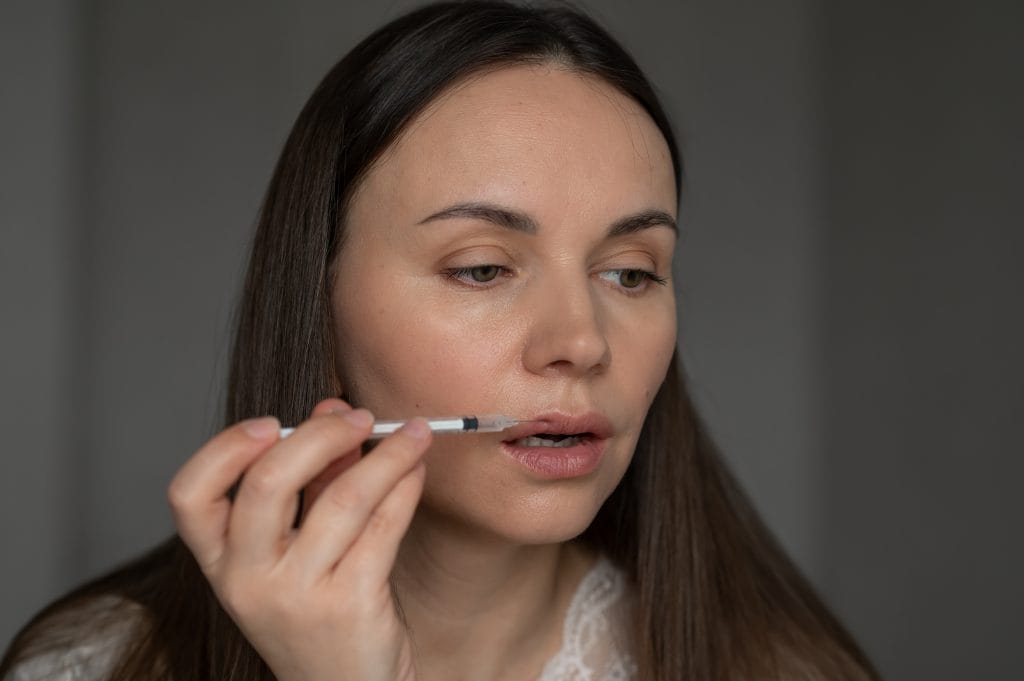
Migrated filler is a clinical shorthand for filler material that appears outside the intended treatment zone, but the underlying issue is not always true product movement. In practice, a changed contour can also reflect edema (swelling), superficial placement, delayed redistribution, or an inflammatory process. That distinction matters because the next step depends on the filler class, the facial area, the timing of onset, and whether symptoms suggest a routine aesthetic issue or a higher-risk complication. For clinic teams, the goal is to recognize the pattern, rule out urgent causes, and document a management path that fits the product used.
Key Takeaways
- Not every late contour change is true migration.
- History, anatomy, and filler type guide the workup.
- High-motion areas and repeated layering need closer review.
- HA and non-HA fillers do not share the same correction options.
- Urgent symptoms require escalation before cosmetic correction.
Why it matters: The right label changes both the safety screen and the treatment plan.
How Migrated Filler Presents in Practice
In clinic practice, migrated filler usually presents as volume, fullness, or an altered contour beyond the planned border of treatment. The lips, perioral area, tear trough, and malar region are frequent concern zones because small shape changes are easy to see and repeat treatments are common. Patients may describe a shelf above the lip, under-eye puffiness, cheek fullness in an unexpected place, or asymmetry that becomes more obvious in animation.
True displacement means filler is present beyond the intended border or compartment. Apparent migration is broader. It includes swelling that exaggerates the border, product that was too superficial from the start, and fullness created by cumulative retreatment. This is why a patient saying the filler moved is a starting point, not a diagnosis.
The timing can vary. Some concerns appear soon after treatment when product sits too superficially or edema distorts the contour. Others appear later, after repeat sessions, tissue movement, or changes in facial support. How long the change remains visible also varies. Swelling-driven changes may settle, while retained product or integrated material can remain noticeable for much longer.
That is why teams should review both product class and treatment design, not just the complaint. A quick refresher on the Dermal Fillers Hub and broader Facial Aesthetic Planning workflow can help standardize how clinicians assess late contour problems.
This briefing is intended for licensed clinic teams and medical professionals.
How to Recognize It and Rule Out Mimics
When a patient presents with suspected migrated filler, the exam should first separate true displacement from common mimics. History matters: what product was used, where it was placed, when the change first appeared, whether the area was manipulated, and whether there is pain, warmth, erythema (redness), or vision change. Examination should include the face at rest, in animation, and on palpation, with comparison to baseline images when they are available.
| Presentation | Typical Clues | Why It Matters |
|---|---|---|
| Likely displacement | Fullness extends beyond the intended border and stays consistent | May represent filler outside the target plane or compartment |
| Edema or fluid shift | Soft swelling that fluctuates through the day | Often needs a different approach than dissolution alone |
| Superficial placement | Visible ridge, palpable ribbon, or Tyndall effect with a bluish cast | Placement depth may be the main issue rather than travel |
| Inflammatory nodule | Discrete lump with tenderness, firmness, or redness | Raises concern for delayed reaction or infection |
Photography often clarifies pattern better than memory. Compare front and oblique views, then assess animation. Ask whether the contour changes through the day, worsens after salt, heat, or exercise, or improves between visits. Fluctuation suggests fluid dynamics more than stable material placement.
Site matters. In lips, a soft ledge above the vermilion border may reflect superficial placement or cumulative treatment. At the tear trough-midface junction, persistent puffiness can be edema rather than filler physically traveling. In cheeks or jawline, asymmetry may relate to deep bolus placement, facial asymmetry, or weight change rather than true migration. The key anatomic question is whether the current fullness still matches the intended plane.
Ultrasonography (ultrasound) can help in more complex cases, especially when prior records are incomplete or the filler class is uncertain. It may help localize material, distinguish fluid from product, and support a more precise plan. Even without imaging, careful differential diagnosis is essential because late swelling, malar edema, superficial visibility, and inflammatory nodules can all be mistaken for migration.
Red flags change the pathway. Disproportionate pain, skin blanching, livedoid or dusky discoloration, progressive erythema, drainage, fever, or any visual complaint should prompt urgent reassessment rather than routine cosmetic follow-up.
Why Filler Seems to Move
Filler appears to move when the product, the tissue, or both allow volume to sit outside the ideal plane. The mechanism may be immediate placement error, later redistribution within tissue, repeated overcorrection, or simple misreading of chronic swelling as product movement. Published literature describes several possible mechanisms rather than one universal cause.
Patient and tissue factors
Thin tissue coverage, laxity, prior surgery, scar, high mobility, and lymphatic vulnerability can all affect how a treated area looks over time. The under-eye and lip region are especially sensitive because small changes in edema or support are visible. Repeated treatment of a tight or already full compartment can create a stepped contour that reads as migration even when the product has not traveled far.
Pressure and motion can contribute, but they rarely explain a case on their own. A mobile anatomic region, layered retreatment, and incomplete interval reassessment are more plausible drivers. Over time, a small amount of misplaced or stacked product can become a persistent shape problem even if no active movement is occurring.
Product and technique factors
Material properties, injection depth, bolus size, layering, and follow-up interval all matter. Superficial placement may create a visible ridge or color shift. Larger or repeated deposits in a mobile area may be harder to control aesthetically. Technique choice can improve precision, but no device or method removes risk altogether. When teams review setup, tools such as the SoftFil Precision Micro-Cannula may fit selected plans, while treatment maps should still define the target plane, endpoint, and reassessment process.
Material review is equally important. If prior notes show a hyaluronic acid filler such as Juvederm Ultra or Restylane Kysse, correction options may differ from those for materials such as Radiesse or HarmonyCa. The point is not brand preference. It is reversibility, tissue response, and realistic planning.
What Clinics Can Do Next
Management of migrated filler starts with verification, not immediate dissolution or massage. Confirm the original product if possible, define the affected area, and decide whether the issue is primarily aesthetic, inflammatory, or urgent. Minor stable contour change may allow planned review and staged correction, while acute pain or ischemic-looking skin requires a different pathway.
- Verify records: confirm product class, treatment site, date, and any prior correction.
- Map the area: assess rest, animation, palpation, and photo comparison.
- Screen for urgency: document pain, color change, warmth, drainage, or visual symptoms.
- Clarify the differential: consider edema, superficial placement, nodules, and asymmetry.
- Choose the pathway: observe, image, correct, or escalate based on findings.
- Record the plan: capture rationale, consent discussion, and follow-up triggers.
How long the appearance lasts depends on the material and on what is actually being seen. Swelling-related contour change may improve as inflammation settles. Integrated filler or non-HA material may remain visible longer and sometimes needs a different correction strategy. For that reason, teams should avoid promising a fixed timeline during the first review.
For hyaluronic acid fillers, some clinics may consider protocol-based assessment for enzymatic correction. A reference point on this site is Liporase Hyaluronidase, but suitability depends on the filler used, consent, local scope, and clinic governance. Non-HA materials do not share the same response profile, so management may involve observation, imaging, referral, or staged correction rather than dissolution.
One practical point is often missed: manual manipulation rarely fixes an established contour problem. If the concern is edema, massage may increase swelling. If it is retained material, pressure may distort rather than resolve the shape. Clear diagnosis comes first.
Product sourcing should be checked against vetted distributor records.
Documentation, Communication, and Prevention
Good documentation often determines whether a late filler concern can be managed efficiently. A charted migrated filler case should capture the material used, site mapping, intended plane, volume per area, lot data, photo set, onset of concern, symptom progression, and any interval procedures or illness that may affect swelling. If prior information is incomplete, note the uncertainty instead of reverse-engineering a precise answer.
Quick tip: Photograph the face at rest and in animation before deciding that fullness has changed position.
Prevention is less about a single ideal product and more about process. Conservative layering, careful plane selection, scheduled reassessment, and restraint in high-motion areas reduce the chance that a late contour issue will be mislabeled or missed. Standardized counseling should explain that swelling, superficial visibility, and delayed texture change can occur, and that not every late change represents literal filler travel.
Prevention also depends on inventory and source discipline. If a patient arrives from another clinic or with incomplete product history, do not assume interchangeability across filler classes. Re-treatment decisions are safer when the original material can be traced to labeled stock and when the chart distinguishes a specific brand from a broad category.
Related workflow matters too. Clinics updating injectable protocols may compare filler pathways with other treatment types, such as What Is Mesotherapy, because the material class, persistence, and complication response differ. This is also part of safer preparation in High-Demand Procedures, where late follow-up concerns are easier to manage when documentation and sourcing are already standardized.
Use verified supply channels when replacing or reviewing filler stock.
Authoritative Sources
- For device safety and adverse-event context, FDA Dermal Fillers and Soft Tissue Fillers.
- For mechanisms described in the literature, Filler Migration: A Number of Mechanisms to Consider.
- For a broader review of post-injection movement and complications, Filler Migration after Facial Injection.
In short, suspected migration is a pattern to assess, not a label to apply automatically. The material used, the treatment plane, the anatomy involved, and the presence or absence of red flags determine the next step far more than shorthand used in casual discussion.
This content is for informational purposes only and is not a substitute for professional medical advice.




