
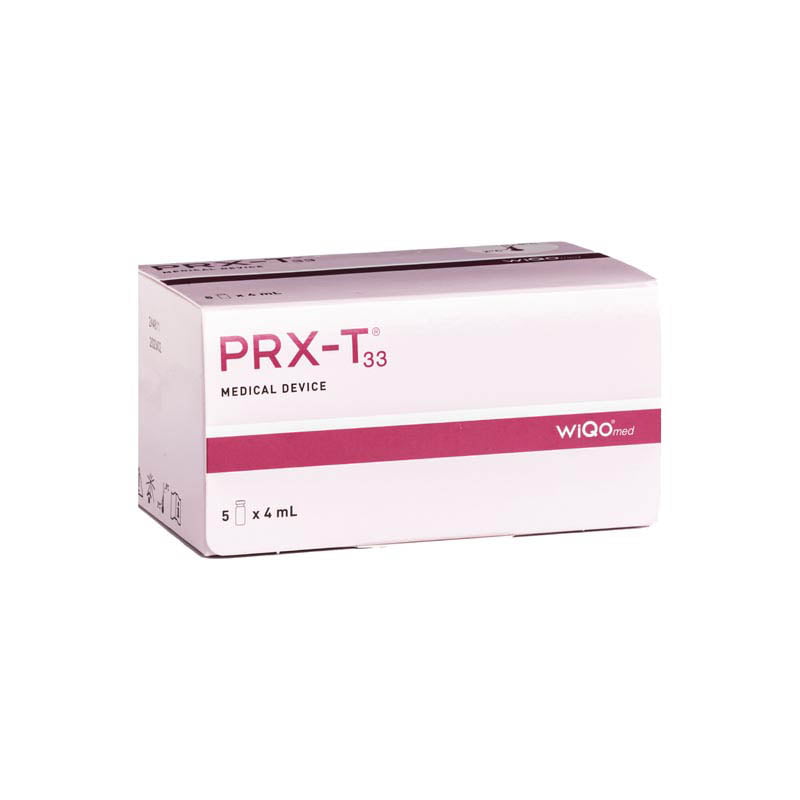
PRX-T33® (WiQo)
Order PRX-T33® WiQo for Clinics
Non-Injectable Skin Rejuvenation Treatment
$259.00
You save
Description
PRX-T33® (WiQo) is a professional, non-injectable biorevitalizing peel for in-office skin-quality protocols. Licensed clinics, med spas, and healthcare professionals can order the 5 x 4 mL vial pack for planned treatment-room use, inventory allocation, and protocol documentation. The topical preparation fits face and selected body workflows where a controlled, non-ablative approach is preferred.
Clinic Ordering, Pack Size, and Price Access
PRX-T33® WiQo is supplied as a clinic-ready box containing 5 vials of 4 mL each. The unitized format helps practices allocate vials by provider, treatment room, or scheduled series without opening a larger shared container. Each vial is sealed for immediate professional use and supports traceable recordkeeping through labeled lot and expiry information.
Sign in with a verified business account to view the current PRX-T33 WiQo price, pack availability, and account-specific purchasing tiers. Pricing may vary with volume, contract terms, and allocation planning for multi-location groups. Administrative teams can align ordering with forecasted session counts, provider schedules, and campaign calendars before submitting purchase requests.
Clinic documentation requirements may apply for professional-use ordering. We review business account details and authorized users to keep ordering aligned with licensed healthcare and aesthetic practice procurement. PRX-T33 US shipping is supported through reliable US logistics, with temperature-controlled handling when required and tracked US delivery.
What PRX-T33® by WiQo Is
PRX T33 by WiQo is a topical peel system that combines trichloroacetic acid with hydrogen peroxide in an aqueous vehicle. In professional aesthetic use, the preparation is selected to support dermal biorevitalization while limiting the visible surface exfoliation commonly associated with traditional chemical peels. The treatment is applied externally by trained staff rather than injected.
The clinical rationale is based on controlled chemical stimulation. Trichloroacetic acid is a well-known peeling agent, while hydrogen peroxide in the formulation helps moderate superficial disruption when the product is used according to professional protocol. This balance makes the WiQo peel treatment useful for clinics that want skin-quality support without adding cannulas, needles, or device-based energy to the visit.
Common professional objectives include improving the appearance of dull texture, photoaged skin quality, uneven tone, fine lines, superficial scarring, and stretch marks. Results and treatment planning depend on skin assessment, technique, session spacing, and the broader care plan. For protocol-focused background, see PRX-T33 protocol basics for licensed aesthetic clinics.
Professional Applications and Treatment-Room Fit
The PRX-T33 facial peel can be scheduled as a stand-alone skin-quality procedure or incorporated into broader aesthetic programs. Clinics often use topical biorevitalizing peels when they want a short treatment block, simple room setup, and minimal equipment burden. Staff should follow manufacturer directions and internal protocols for application sequence, exposure management, cleansing, and post-procedure instructions.
Professional treatment areas may include the face, neck, decolletage, hands, and selected body zones when appropriate for the clinic protocol. Practices should evaluate skin condition, treatment history, sensitivity, contraindication concerns, and timing around other procedures before use. The peel may be staged separately from injectable, thread, or device services to reduce irritation risk and keep outcomes easier to evaluate.
For broader category planning, browse professional peels and masks. Clinics building hyperpigmentation or tone-focused workflows may also use educational support from chemical peel considerations for dark spots, while anti-aging program planning can be informed by chemical peels in anti-aging protocols.
Expected Skin-Quality Role and Result Timing
PRX-T33® is used in aesthetic medicine to support the appearance of firmness, elasticity, texture, radiance, and overall skin quality. It is not a substitute for neuromodulators, dermal fillers, resurfacing lasers, or surgical procedures. It works in a different category: topical biorevitalization rather than muscle relaxation, volume restoration, or ablative resurfacing.
Search interest often asks whether PRX-T33 really works or how long results last. In clinic copy and consultations, the safest answer is protocol-based: visible changes vary by baseline skin condition, treatment area, number of sessions, aftercare, sun exposure, and maintenance planning. Providers should avoid guaranteed before-and-after claims and instead document objective skin findings, photographs when appropriate, product lot use, and patient-reported tolerance.
PRX-T33 is also not “better than Botox” because the two options address different aesthetic goals. Botulinum toxin products reduce dynamic muscle activity that contributes to expression lines. A WiQo PRX-T33 facial peel is a topical skin-quality procedure intended for texture and biorevitalization workflows. Many clinics position them as separate tools within a complete aesthetic plan rather than direct replacements.
Key Features for Clinic Workflow
- Topical, non-injectable application for trained professional staff.
- Biorevitalizing peel profile for skin-quality programs.
- Trichloroacetic acid and hydrogen peroxide formulation.
- Designed for controlled action with limited surface disruption when used properly.
- Suitable for face and selected body protocols under clinic direction.
- 5 x 4 mL vial packaging supports planned session allocation.
- Sealed vials help maintain organized treatment-room handling.
- Lot and expiry labeling supports traceability and inventory records.
Quick tip: Assign vials to booked treatment blocks before the clinic day to reduce room-to-room inventory movement.
Composition, Mechanism, and Handling
The preparation contains trichloroacetic acid and hydrogen peroxide in an aqueous vehicle, with inactive components and stabilizers described by manufacturer labeling. Trichloroacetic acid is used in dermatology as a chemical peeling agent. In PRX-T33®, the formulation is designed for a biorevitalizing effect while aiming to temper superficial irritation when the professional protocol is followed.
Handling should remain consistent across providers. Clinics should store the product according to manufacturer instructions, keep vials sealed until use, and avoid substituting application steps without clinical review. Staff should record lot, expiry, treatment area, volume used when part of the clinic’s SOP, observed skin response, and post-care instructions. Standardized documentation is especially useful in multi-provider settings.
PRX-T33 WiQo peel kit inventory should be managed with expiry rotation and clear allocation rules. Practices can reserve stock for active treatment series, seasonal campaigns, or consultation-to-treatment conversion days. The 5-vial pack supports short series scheduling and helps reduce the need for last-minute product transfers between rooms or locations.
Safety, Precautions, and Professional Assessment
As with other professional chemical peels, PRX-T33® should be used only after a clinical skin assessment and review of treatment suitability. Providers should consider skin barrier condition, recent procedures, active irritation, infection, allergy history, photosensitivity concerns, and recent use of potentially irritating topical products. Individual contraindications and deferral criteria should follow manufacturer instructions and the clinic’s medical oversight policies.
Transient erythema, tingling, warmth, mild swelling, dryness, or temporary sensitivity may occur. More significant irritation, prolonged redness, pigmentary change, or unexpected reactions require clinical evaluation and appropriate documentation. Staff should provide post-procedure instructions that cover cleansing, sun protection, avoidance of unnecessary irritation, and when to contact the clinic.
Clinics should avoid presenting the treatment as risk-free because minimal visible peeling does not mean no biologic activity. The product is still a professional chemical peel preparation. Informed consent, staff training, patch or sensitivity considerations when clinically appropriate, and conservative sequencing with other procedures help reduce avoidable adverse events.
Comparable Products and Adjacent Choices
Clinics evaluating PRX-T33® may also compare other peel systems by depth, active ingredients, expected downtime, target indication, and staff familiarity. For a TCA-based alternative in the professional peel category, review Melases TRX TCA 10 Peel. For antioxidant-oriented peel planning, see Ferulac Peel Plus.
Brightening protocols may call for different preparations depending on skin type, sensitivity, and post-care planning. Related choices include Fillmed Bright Peel Normal Skin and pre-treatment support such as Filorga Pre Peel 1. Selection should stay aligned with clinic training, patient assessment, manufacturer directions, and desired treatment depth.
Skin-quality programs often include cleansers, masks, barrier support, or maintenance products after professional procedures. Browse professional skincare to coordinate adjunct products with your clinic’s post-care standards. For workflow and safety comparisons across peel types, chemical peel workflow and safety essentials offers useful operational context.
Availability, Substitutions, and Brand Consistency
PRX-T33® (WiQo) should be ordered by the intended brand, pack, and vial count when maintaining a defined clinic protocol. Naming may vary across markets and professional discussions, including PRX T33 WiQo, WiQo PRX, PRX-T33 WiQo Med, or PRX reverse peel WiQo. Those names should not be used as proof of a different formulation, strength, or pack size without documentation.
If a substitution is being considered, compare active ingredients, manufacturer, packaging, training requirements, and protocol expectations before approving the switch. Document internal equivalence decisions so front-desk staff, providers, and inventory managers work from the same assumptions. Consistency matters when practices track outcomes, tolerance, and repeat-treatment scheduling.
Authoritative Sources
For independent background on professional peel actives and chemical peel principles, consult manufacturer and scientific references:
This content is for informational purposes only and is not a substitute for professional medical advice.
Frequently Asked Questions
Who can order PRX-T33® WiQo from Med Wholesale Supplies?
PRX-T33® WiQo is intended for licensed clinics, med spas, aesthetic practices, and healthcare professionals using professional in-office protocols. A verified business account is required to view account pricing and submit purchase requests.
What is included in the PRX-T33® WiQo pack?
The supplied presentation is a clinic-ready box with 5 sealed vials of 4 mL each. Labels include lot and expiry information to support inventory control and treatment documentation.
Is PRX-T33® the same as Botox?
No. PRX-T33® is a topical biorevitalizing peel used for skin-quality protocols. Botox is a neuromodulator used for dynamic muscle-related lines. Clinics may use them for different aesthetic goals within separate protocols.
How should clinics handle PRX-T33® inventory?
Keep vials sealed until use, store according to manufacturer instructions, rotate by expiry, and record lot and expiry in treatment documentation. Allocating vials to scheduled treatment blocks can simplify room workflow.
What side effects should providers discuss before treatment?
Temporary redness, tingling, warmth, mild swelling, dryness, or sensitivity may occur. Providers should assess skin condition, review contraindication concerns, obtain appropriate consent, and give post-care instructions before use.
Can PRX-T33® be combined with other aesthetic procedures?
Clinics may include PRX-T33® in broader aesthetic programs, but sequencing should follow manufacturer directions, clinical assessment, and internal medical protocols. Staging procedures separately can help manage irritation and document response.
Specifications
- Main Ingredient: Trichloroacetic Acid (Tca) And Hydrogen Peroxide
- Manufacturer: WiQo Italia S.r.l.
- Drug Class: Cosmetic Skincare Product
- Generic Name: Trichloroacetic Acid (Tca) And Hydrogen Peroxide
- Package Contents: 4ML x 5 Vials
- Storage Requirements: Cool Temperature (2℃~8℃)
- Main Usage: Anti Ageing
About the Brand
Prx-T33 (Wiqo)
Revolutionary in its approach to skin rejuvenation, Prx-T33, or Wiqo as it's also known, represents a shift in the medical cosmetic industry. Enriched with innovative elements, Prx-T33 is noteworthy for its ability to deliver profound results without inflicting any discomfort or delay in patients' routines which makes it an optimal choice for those seeking to enhance their skin condition without resorting to invasive methods. We strive to make your shopping experience smooth and easy at our online shopping portal, medwholesalesupplies.com, where Wiqo (Prx-T33) is easily accessible. We are proud to make this groundbreaking product available for medical professionals and clinics aiming to provide only the best skincare treatments to their patients. In addition to this, our website presents comprehensive details on the product, guidelines for use, and anticipated results, enabling medical practitioners to make well-informed judgments when choosing suitable treatments for their patients. At MedWholesaleSupplies.com, we have streamlined the process of purchasing Prx-T33 (Wiqo), delivering a hassle-free and secure platform for medical professionals to acquire the product swiftly and proficiently. We offer dependable shipping methods and an attentive customer service team for any inquiries, ensuring unbroken access to the products necessary to deliver exceptional results to patients. By procuring Prx-T33 through medwholesalesupplies.com, healthcare professionals can conserve time and minimize effort while providing their patients with the latest trends in skin rejuvenation treatments.
Browse Prx-T33 (Wiqo) Products
Here to help
Questions about ordering, delivery or products? You can email our team here or call now at 1-800-630-9757 and be connected with your dedicated Account Manager
Related Products
Evenity® (English Alternative)
Injectable Medication
$1,229.00 - $1,299.00
You save
You save
Intraline® For Men
Dermal Filler
$59.00 - $79.00
You save
You save
RejuvaNAD+ Pro
Injectable Medication
$237.00 - $249.00
You save
You save
Teosyal® RHA 4
Aesthetic Surgery Product
$259.00 - $279.00
You save
You save
Related Articles
Prednisone in Clinical Care: Uses, Risks, and Monitoring
Prednisone is a prescription systemic corticosteroid used to reduce inflammation or suppress immune activity in…
Lip Fillers Swelling Stages: Timeline, Safety, and Follow-Up
Lip fillers swelling stages usually follow a short inflammatory course: swelling appears soon after injection,…
Hypopigmentation of the Skin: Assessment and Care
Hypopigmentation of the skin means one or more areas look lighter than the surrounding skin.…
Radiesse vs Sculptra: Selection Factors for Clinics
Radiesse vs Sculptra is best understood as a comparison between two collagen-stimulating injectables with different…
Hyaluronic Acid Under-Eye Filler: Safety and Workflow
Hyaluronic acid under-eye filler is an injectable soft-tissue filler used by trained aesthetic clinicians to…
Dermal Filler Types: Materials, Uses, and Clinic Fit
Dermal filler types are usually grouped by their base material, tissue behavior, and expected role…
What Is Dysport? Clinical Uses, Safety, and Workflow
For clinic teams asking what is Dysport, the short answer is simple: Dysport is a…
Biostimulators in Aesthetic Care: Selection and Safety
Biostimulators are injectable aesthetic products used to encourage a controlled tissue response, often involving new…